
Ch. 5 - Integration
Briggs - Calculus: Early Transcendentals 3rd Edition
Briggs3rd EditionCalculus: Early TranscendentalsISBN: 9780136847243Not the one you use?Change textbook
Chapter 5, Problem 5.3.107c

Explain why or why not Determine whether the following statements are true and give an explanation or counterexample.                                                                          
                                                                                                                                                                                     (c) The functions p(𝓍) = sin 3𝓍 and q(𝓍) = 4 sin 3𝓍 are antiderivatives of the same function. 

Verified step by step guidance
1
Recall the definition of antiderivatives: Two functions are antiderivatives of the same function if their derivatives are equal.
Find the derivative of the first function \(p(\mathcal{x}) = \sin 3\mathcal{x}\) using the chain rule: \(p'(\mathcal{x}) = 3 \cos 3\mathcal{x}\).
Find the derivative of the second function \(q(\mathcal{x}) = 4 \sin 3\mathcal{x}\) similarly: \(q'(\mathcal{x}) = 4 \cdot 3 \cos 3\mathcal{x} = 12 \cos 3\mathcal{x}\).
Compare the derivatives \(p'(\mathcal{x}) = 3 \cos 3\mathcal{x}\) and \(q'(\mathcal{x}) = 12 \cos 3\mathcal{x}\). Since they are not equal, \(p\) and \(q\) are not antiderivatives of the same function.
Conclude that the statement is false because the derivatives differ by a constant factor, so \(p\) and \(q\) cannot both be antiderivatives of the same function.

Verified video answer for a similar problem:

This video solution was recommended by our tutors as helpful for the problem above.
Video duration:
2m
Was this helpful?

Key Concepts

Here are the essential concepts you must grasp in order to answer the question correctly.

Antiderivative (Indefinite Integral)

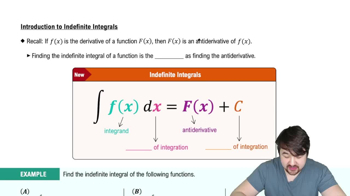
An antiderivative of a function f(x) is another function F(x) whose derivative is f(x). It represents the family of all functions differing by a constant, since differentiation eliminates constants. For example, if F'(x) = f(x), then F(x) + C is the general antiderivative.
Recommended video:
05:04
Introduction to Indefinite Integrals

Linearity of Differentiation

Differentiation is a linear operation, meaning the derivative of a constant multiple of a function is the constant times the derivative of the function. For instance, if g(x) = kΒ·f(x), then g'(x) = kΒ·f'(x). This property helps compare functions to determine if they share the same derivative.
Recommended video:
07:17
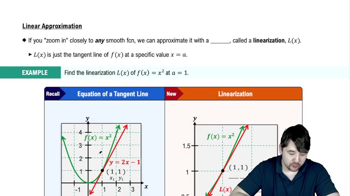
Linearization

Checking if Two Functions are Antiderivatives of the Same Function

Two functions are antiderivatives of the same function if their derivatives are identical. If their derivatives differ, they cannot be antiderivatives of the same function. For example, p(x) = sin(3x) and q(x) = 4 sin(3x) have different derivatives, so they are not antiderivatives of the same function.
Recommended video:
06:21
Properties of Functions
Related Practice
Textbook Question

Explain why or why not Determine whether the following statements are true and give an explanation or counterexample.

(c) The average value of a linear function on an interval [a, b] is the function value at the midpoint of [a, b] .

Textbook Question

{Use of Tech} Approximating definite integrals Complete the following steps for the given integral and the given value of n. 

(d) Determine which Riemann sum (left or right) underestimates the value of the definite integral and which overestimates the value of the definite integral.


βˆ«β‚β· 1/𝓍 d𝓍 ; n = 6

Textbook Question

Properties of integrals Use only the fact that βˆ«β‚€β΄ 3𝓍 (4 ―𝓍) d𝓍 = 32, and the definitions and properties of integrals, to evaluate the following integrals, if possible.

(d) βˆ«β‚€βΈ 3𝓍(4 ― 𝓍) d(𝓍)

Textbook Question

Properties of integrals Suppose βˆ«β‚€Β³Ζ’(𝓍) d𝓍 = 2 , βˆ«β‚ƒβΆΖ’(𝓍) d𝓍 = ―5 , and βˆ«β‚ƒβΆg(𝓍) d𝓍 = 1. Evaluate the following integrals.

(d) βˆ«β‚†Β³ (Ζ’(𝓍) + 2g(𝓍)) d𝓍

Textbook Question

Use Table 5.6 to evaluate the following definite integrals.                                                                                                                    

 (c) βˆ«β‚ƒβˆšβ‚‚^⁢ d𝓍/(𝓍² ―9)

1
views
Textbook Question

{Use of Tech} Approximating definite integrals Complete the following steps for the given integral and the given value of n. 

(c) Calculate the left and right Riemann sums for the given value of n.

βˆ«β‚β· 1/𝓍 d𝓍 ; n = 6