
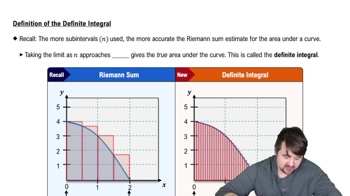
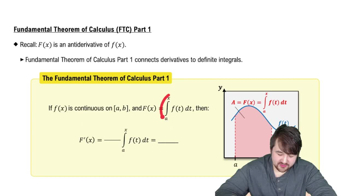
{Use of Tech} Approximating definite integrals with a calculator Consider the following definite integrals.
(b) Evaluate each sum using a calculator with n = 20, 50, and 100. Use these values to estimate the value of the integral.
∫₀¹ (𝓍² + 1) d𝓍
Verified step by step guidance
{Use of Tech} Approximating definite integrals with a calculator Consider the following definite integrals.
(b) Evaluate each sum using a calculator with n = 20, 50, and 100. Use these values to estimate the value of the integral.
∫₀¹ (𝓍² + 1) d𝓍
{Use of Tech} Riemann sums for larger values of n Complete the following steps for the given function f and interval.
ƒ(𝓍) = 3 √x on [0,4] ; n = 40
(b) Based on the approximations found in part (a), estimate the area of the region bounded by the graph of f and the x-axis on the interval.
{Use of Tech} Approximating net area The following functions are positive and negative on the given interval.
f(x) = sin 2x on [0,3π/4]
(b) Approximate the net area bounded by the graph of f and the x-axis on the interval using a left, right, and midpoint Riemann sum with n = 4.
Properties of integrals Suppose ∫₀³ƒ(𝓍) d𝓍 = 2 , ∫₃⁶ƒ(𝓍) d𝓍 = ―5 , and ∫₃⁶g(𝓍) d𝓍 = 1. Evaluate the following integrals.
(b) ∫₃⁶ (―3g(𝓍)) d𝓍
Working with area functions Consider the function ƒ and the points a, b, and c.
(b) Graph ƒ and A.
ƒ(𝓍) = 1/𝓍 ; a = 1 , b = 4 , c = 6
{Use of Tech} Approximating definite integrals with a calculator Consider the following definite integrals.
(b) Evaluate each sum using a calculator with n = 20, 50, and 100. Use these values to estimate the value of the integral.
∫₀¹ cos ⁻¹ 𝓍 d𝓍