Ch. 5 - Integration
Briggs - Calculus: Early Transcendentals 3rd Edition
Briggs3rd EditionCalculus: Early TranscendentalsISBN: 9780136847243Not the one you use?Change textbook
Chapter 5, Problem 5.2.73b

{Use of Tech} Approximating definite integrals with a calculator Consider the following definite integrals.
(b) Evaluate each sum using a calculator with n = 20, 50, and 100. Use these values to estimate the value of the integral.


∫₀¹ cos ⁻¹ 𝓍 d𝓍

Verified step by step guidance
1
Step 1: Understand the problem. The goal is to approximate the definite integral ∫₀¹ cos⁻¹(𝓍) d𝓍 using numerical methods with different values of n (number of subintervals). This involves dividing the interval [0, 1] into n equal parts and using a calculator to compute the sum.
Step 2: Divide the interval [0, 1] into n subintervals. For n = 20, 50, and 100, calculate the width of each subinterval, Δ𝓍 = (1 - 0)/n = 1/n. For example, if n = 20, Δ𝓍 = 1/20 = 0.05.
Step 3: Identify the x-values at which the function cos⁻¹(𝓍) will be evaluated. These x-values are the endpoints of the subintervals: x₀ = 0, x₁ = Δ𝓍, x₂ = 2Δ𝓍, ..., xₙ = 1. For n = 20, the x-values are 0, 0.05, 0.10, ..., 1.
Step 4: Use a numerical integration method, such as the midpoint rule or trapezoidal rule, to approximate the integral. For example, in the midpoint rule, evaluate cos⁻¹(𝓍) at the midpoint of each subinterval and multiply by Δ𝓍. Sum these values to approximate the integral.
Step 5: Repeat the process for n = 50 and n = 100. Compare the results obtained for each value of n to observe how increasing the number of subintervals improves the accuracy of the approximation. Use a calculator to perform the computations efficiently.

Verified video answer for a similar problem:

This video solution was recommended by our tutors as helpful for the problem above.
Video duration:
5m
Was this helpful?

Key Concepts

Here are the essential concepts you must grasp in order to answer the question correctly.

Definite Integrals

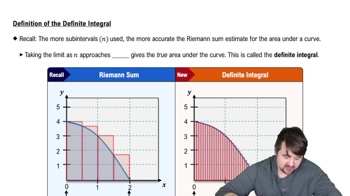
A definite integral represents the signed area under a curve between two specified limits. It is denoted as ∫_a^b f(x) dx, where 'a' and 'b' are the lower and upper limits, respectively. The value of a definite integral can be interpreted as the accumulation of quantities, such as area, over the interval [a, b]. Understanding how to evaluate definite integrals is crucial for approximating their values using numerical methods.
Recommended video:
05:43
Definition of the Definite Integral

Numerical Integration

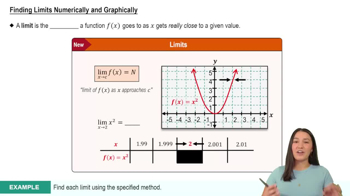
Numerical integration refers to techniques used to approximate the value of definite integrals when an analytical solution is difficult or impossible to obtain. Common methods include the Trapezoidal Rule and Simpson's Rule, which involve partitioning the interval into smaller segments and calculating the area under the curve using geometric shapes. In this context, using a calculator to evaluate sums for different values of 'n' helps estimate the integral's value more accurately.
Recommended video:
6:47
Finding Limits Numerically and Graphically

Limit of Riemann Sums

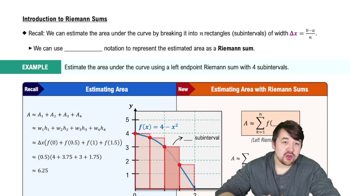
Riemann sums are a method for approximating the value of a definite integral by dividing the area under a curve into rectangles. As the number of rectangles (n) increases, the Riemann sum approaches the exact value of the integral, which is formalized in the definition of the definite integral. Understanding how to compute Riemann sums and their limits is essential for using numerical methods to estimate integrals, especially when using technology like calculators.
Recommended video:
06:11
Introduction to Riemann Sums
Related Practice
Textbook Question

Working with area functions Consider the function ƒ and its graph.

(b) Estimate the points (if any) at which A has a local maximum or minimum.


Textbook Question

{Use of Tech} Approximating definite integrals with a calculator Consider the following definite integrals.

(b) Evaluate each sum using a calculator with n = 20, 50, and 100. Use these values to estimate the value of the integral.


∫₀¹ (𝓍² + 1) d𝓍

1
views
Textbook Question

{Use of Tech} Riemann sums for larger values of n Complete the following steps for the given function f and interval.


ƒ(𝓍) = 3 √x on [0,4] ; n = 40

(b) Based on the approximations found in part (a), estimate the area of the region bounded by the graph of f and the x-axis on the interval.

1
views
Textbook Question

Properties of integrals Consider two functions ƒ and g on [1,6] such that ∫₁⁶ƒ(𝓍) d𝓍 = 10 and ∫₁⁶g(𝓍) d𝓍 = 5, ∫₄⁶ƒ(𝓍) d𝓍 = 5 , and ∫₁⁴g(𝓍) d𝓍 = 2. Evaluate the following integrals.


(b) ∫₁⁶ (f(𝓍) ― g(𝓍)) d𝓍

Textbook Question

Explain why or why not Determine whether the following statements are true and give an explanation or counterexample.

(b) If ƒ is a linear function on the interval [a,b] , then a midpoint Riemann sums give the exact value of ∫ₐᵇ ƒ(𝓍) d𝓍, for any positive integer n. 

Textbook Question

Working with area functions Consider the function ƒ and its graph.

(b) Estimate the points (if any) at which A has a local maximum or minimum.


1
views