Ch. 5 - Integration
Briggs - Calculus: Early Transcendentals 3rd Edition
Briggs3rd EditionCalculus: Early TranscendentalsISBN: 9780136847243Not the one you use?Change textbook
Chapter 5, Problem 5.2.35

Identifying definite integrals as limits of sums Consider the following limits of Riemann sums for a function Ζ’ on [a,b]. Identify Ζ’ and express the limit as a definite integral.                                
          n                                                                                                                                                                              
    lim   βˆ‘ (𝓍ₖ*Β² + 1) βˆ†π“β‚– on [0,2]                                                                                                                                                                            
  βˆ† β†’ 0   k=1                                                                                                                                                                                                                      

Verified step by step guidance
1
Step 1: Recognize the structure of the given limit. The expression lim βˆ‘ (𝓍ₖ² + 1) βˆ†π“β‚– as βˆ† β†’ 0 represents a Riemann sum. A Riemann sum approximates the area under a curve by summing up the areas of rectangles, where the height of each rectangle is determined by the function value at a specific point within the interval.
Step 2: Identify the function Ζ’(𝓍) from the given Riemann sum. The term (𝓍ₖ² + 1) corresponds to the function Ζ’(𝓍) = 𝓍² + 1. This is the function being integrated over the interval [0, 2].
Step 3: Determine the interval of integration. The problem specifies the interval [0, 2], which means the definite integral will be evaluated from 𝓍 = 0 to 𝓍 = 2.
Step 4: Express the limit as a definite integral. The limit of the Riemann sum as βˆ† β†’ 0 is equivalent to the definite integral of the function Ζ’(𝓍) = 𝓍² + 1 over the interval [0, 2]. Using integral notation, this is written as: a0b2x2+1dx
Step 5: Conclude the process. The definite integral a0b2x2+1dx represents the exact area under the curve Ζ’(𝓍) = 𝓍² + 1 from 𝓍 = 0 to 𝓍 = 2.

Verified video answer for a similar problem:

This video solution was recommended by our tutors as helpful for the problem above.
Video duration:
2m
Was this helpful?

Key Concepts

Here are the essential concepts you must grasp in order to answer the question correctly.

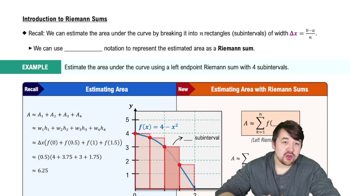
Riemann Sums

Riemann sums are a method for approximating the definite integral of a function over an interval by dividing the interval into smaller subintervals. For each subinterval, a sample point is chosen, and the function's value at that point is multiplied by the width of the subinterval. As the number of subintervals increases and their width decreases, the Riemann sum approaches the exact value of the definite integral.
Recommended video:
06:11
Introduction to Riemann Sums

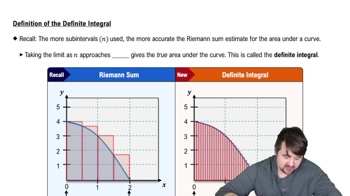
Definite Integrals

A definite integral represents the signed area under a curve defined by a function over a specific interval [a, b]. It is denoted as ∫[a,b] f(x) dx and can be interpreted as the limit of Riemann sums as the number of subintervals approaches infinity. Definite integrals have numerous applications in calculating areas, volumes, and solving problems in physics and engineering.
Recommended video:
05:43
Definition of the Definite Integral

Limits

In calculus, a limit describes the behavior of a function as its input approaches a certain value. When evaluating Riemann sums, the limit is taken as the width of the subintervals approaches zero, which allows for the transition from a sum of areas of rectangles to the exact area under the curve. Understanding limits is crucial for grasping the foundational concepts of continuity, derivatives, and integrals.
Recommended video:
05:50
One-Sided Limits