Ch. 5 - Integration
Briggs - Calculus: Early Transcendentals 3rd Edition
Briggs3rd EditionCalculus: Early TranscendentalsISBN: 9780136847243Not the one you use?Change textbook
Chapter 5, Problem 5.3.73

Derivatives of integrals Simplify the following expressions.


d/d𝓍 βˆ«β‚ƒΛ£ (tΒ² + t + 1) dt

Verified step by step guidance
1
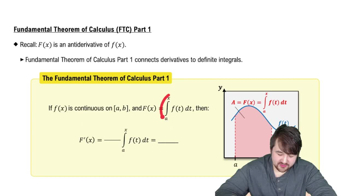
Recognize that the problem involves the Fundamental Theorem of Calculus, which states that if F(x) = βˆ«β‚Λ£ f(t) dt, then dF/dx = f(x).
Identify the integral bounds: the lower bound is a constant (3), and the upper bound is the variable (x). This means the derivative will be evaluated at the upper bound.
Apply the Fundamental Theorem of Calculus: d/d𝓍 βˆ«β‚ƒΛ£ (tΒ² + t + 1) dt = (tΒ² + t + 1) evaluated at t = x.
Substitute t = x into the integrand: (xΒ² + x + 1).
Conclude that the derivative simplifies to xΒ² + x + 1, as the lower bound being constant does not contribute to the derivative.

Verified video answer for a similar problem:

This video solution was recommended by our tutors as helpful for the problem above.
Video duration:
1m
Was this helpful?

Key Concepts

Here are the essential concepts you must grasp in order to answer the question correctly.

Fundamental Theorem of Calculus

The Fundamental Theorem of Calculus links differentiation and integration, stating that if F is an antiderivative of f on an interval, then the integral of f from a to b can be computed using F(b) - F(a). This theorem is crucial for simplifying expressions involving derivatives of integrals, as it allows us to evaluate the derivative of an integral directly.
Recommended video:
06:11
Fundamental Theorem of Calculus Part 1

Chain Rule

The Chain Rule is a fundamental principle in calculus used to differentiate composite functions. When differentiating an integral with variable limits, the Chain Rule helps in managing the relationship between the outer function (the derivative) and the inner function (the integral), ensuring that we account for changes in the variable of integration.
Recommended video:
05:02
Intro to the Chain Rule

Definite Integral

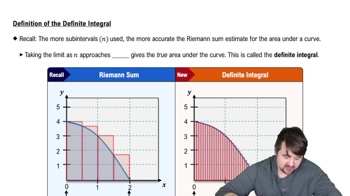
A definite integral represents the accumulation of a function's values over a specific interval, providing a numerical result. In the context of the given expression, understanding how to evaluate the definite integral from 3 to x is essential for applying the Fundamental Theorem of Calculus and simplifying the expression correctly.
Recommended video:
05:43
Definition of the Definite Integral
Related Practice
Textbook Question

Definite integrals Evaluate the following integrals using the Fundamental Theorem of Calculus


βˆ«β‚βΈ 8𝓍¹/Β³ d𝓍

1
views
Textbook Question

Identifying definite integrals as limits of sums Consider the following limits of Riemann sums for a function Ζ’ on [a,b]. Identify Ζ’ and express the limit as a definite integral.                                

          n                                                                                                                                                                              

    lim   βˆ‘ (𝓍ₖ*Β² + 1) βˆ†π“β‚– on [0,2]                                                                                                                                                                            

  βˆ† β†’ 0   k=1                                                                                                                                                                                                                      

Textbook Question

Definite integrals Evaluate the following integrals using the Fundamental Theorem of Calculus. Explain why your result is consistent with the figure.


βˆ«β‚€ΒΉ (𝓍² β€• 2𝓍 + 3) d𝓍


Textbook Question

Average values Find the average value of the following functions on the given interval. Draw a graph of the function and indicate the average value.

Ζ’(𝓍) = cos 𝓍 on [―π/2 , Ο€/2]

1
views
Textbook Question

If Ζ’ is an odd function, why is βˆ«α΅ƒβ‚‹β‚ Ζ’(𝓍) d𝓍 = 0?

Textbook Question

Mean Value Theorem for Integrals Find or approximate all points at which the given function equals its average value on the given interval.


Ζ’(𝓍) = 1 ― |𝓍| on [―1, 1]

1
views