Ch. 5 - Integration
Briggs - Calculus: Early Transcendentals 3rd Edition
Briggs3rd EditionCalculus: Early TranscendentalsISBN: 9780136847243Not the one you use?Change textbook
Chapter 5, Problem 5.R.43

Evaluating integrals Evaluate the following integrals.


∫₀¹ √𝓍 (√𝓍 + 1) d𝓍

Verified step by step guidance
1
Step 1: Begin by expanding the integrand. The given integral is ∫₀¹ √𝓍 (√𝓍 + 1) d𝓍. Distribute √𝓍 across the terms inside the parentheses to rewrite the integrand as ∫₀¹ (𝓍 + √𝓍) d𝓍.
Step 2: Split the integral into two separate integrals for easier computation: ∫₀¹ (𝓍 + √𝓍) d𝓍 = ∫₀¹ 𝓍 d𝓍 + ∫₀¹ √𝓍 d𝓍.
Step 3: Evaluate the first integral, ∫₀¹ 𝓍 d𝓍. Use the power rule for integration, which states ∫𝓍ⁿ d𝓍 = (𝓍ⁿ⁺¹)/(n+1) + C, where n ≠ -1. Here, n = 1, so ∫₀¹ 𝓍 d𝓍 = [𝓍²/2]₀¹.
Step 4: Evaluate the second integral, ∫₀¹ √𝓍 d𝓍. Rewrite √𝓍 as 𝓍^(1/2) and apply the power rule for integration. For n = 1/2, ∫𝓍^(1/2) d𝓍 = (𝓍^(3/2))/(3/2) + C. Simplify to (2/3)𝓍^(3/2). Evaluate this expression from 0 to 1: [(2/3)𝓍^(3/2)]₀¹.
Step 5: Combine the results of the two integrals. Add the evaluated results of ∫₀¹ 𝓍 d𝓍 and ∫₀¹ √𝓍 d𝓍 to obtain the final value of the integral ∫₀¹ √𝓍 (√𝓍 + 1) d𝓍.

Verified video answer for a similar problem:

This video solution was recommended by our tutors as helpful for the problem above.
Video duration:
3m
Was this helpful?

Key Concepts

Here are the essential concepts you must grasp in order to answer the question correctly.

Definite Integrals

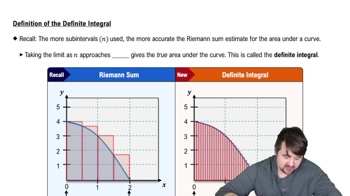
A definite integral represents the signed area under a curve between two specified limits. In this case, the integral ∫₀¹ √𝓍 (√𝓍 + 1) d𝓍 is evaluated from 0 to 1, which means we are calculating the area under the curve of the function √𝓍 (√𝓍 + 1) from x = 0 to x = 1.
Recommended video:
05:43
Definition of the Definite Integral

Integration Techniques

To evaluate integrals, various techniques can be employed, such as substitution, integration by parts, or recognizing patterns. For the given integral, simplifying the integrand √𝓍 (√𝓍 + 1) may involve expanding the expression or using substitution to make the integration process more manageable.
Recommended video:
06:18
Integration by Parts for Definite Integrals

Fundamental Theorem of Calculus

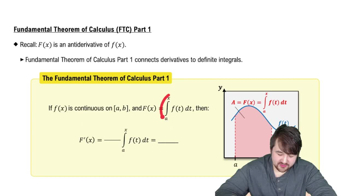
The Fundamental Theorem of Calculus links differentiation and integration, stating that if F is an antiderivative of f on an interval [a, b], then ∫ₐᵇ f(x) dx = F(b) - F(a). This theorem is essential for evaluating definite integrals, as it allows us to find the area under the curve by calculating the difference of the antiderivative at the upper and lower limits.
Recommended video:
06:11
Fundamental Theorem of Calculus Part 1