Ch. 5 - Integration
Briggs - Calculus: Early Transcendentals 3rd Edition
Briggs3rd EditionCalculus: Early TranscendentalsISBN: 9780136847243Not the one you use?Change textbook
Chapter 5, Problem 5.R.26

Use geometry and properties of integrals to evaluate the following definite integrals.
โˆซโ‚„โฐ (2๐“ + โˆš(16โ€•๐“ยฒ)) d๐“ . (Hint: Write the integral as sum of two integrals.)

Verified step by step guidance
1
Step 1: Recognize that the integral can be split into two separate integrals using the property of linearity of integrals: โˆซโ‚„โฐ (2๐“ + โˆš(16โ€•๐“ยฒ)) d๐“ = โˆซโ‚„โฐ 2๐“ d๐“ + โˆซโ‚„โฐ โˆš(16โ€•๐“ยฒ) d๐“.
Step 2: For the first integral, โˆซโ‚„โฐ 2๐“ d๐“, use the power rule for integration. The antiderivative of 2๐“ is ๐“ยฒ. Evaluate this integral over the limits from ๐“ = 0 to ๐“ = 4.
Step 3: For the second integral, โˆซโ‚„โฐ โˆš(16โ€•๐“ยฒ) d๐“, recognize that โˆš(16โ€•๐“ยฒ) represents the equation of a semicircle with radius 4 centered at the origin. The integral computes the area of the semicircle over the interval [0, 4].
Step 4: Use the formula for the area of a semicircle, A = (1/2)ฯ€rยฒ, where r is the radius. Here, r = 4. Compute the area of the semicircle corresponding to the interval [0, 4].
Step 5: Add the results of the two integrals together to obtain the final value of the definite integral โˆซโ‚„โฐ (2๐“ + โˆš(16โ€•๐“ยฒ)) d๐“.

Verified video answer for a similar problem:

This video solution was recommended by our tutors as helpful for the problem above.
Video duration:
3m
Was this helpful?

Key Concepts

Here are the essential concepts you must grasp in order to answer the question correctly.

Definite Integrals

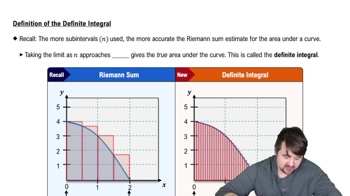
A definite integral represents the signed area under a curve defined by a function over a specific interval. It is denoted as โˆซ[a,b] f(x) dx, where 'a' and 'b' are the limits of integration. The result of a definite integral is a numerical value that can be interpreted geometrically as the area between the curve and the x-axis from 'a' to 'b'.
Recommended video:
05:43
Definition of the Definite Integral

Properties of Integrals

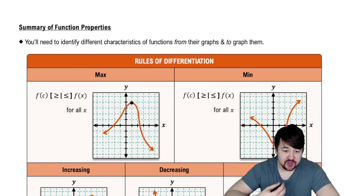
Properties of integrals, such as linearity, allow us to break down complex integrals into simpler parts. For instance, the integral of a sum can be expressed as the sum of integrals: โˆซ[a,b] (f(x) + g(x)) dx = โˆซ[a,b] f(x) dx + โˆซ[a,b] g(x) dx. This property is particularly useful for evaluating integrals that can be separated into more manageable components.
Recommended video:
06:21
Properties of Functions

Geometric Interpretation of Integrals

The geometric interpretation of integrals involves visualizing the area under a curve. For the integral โˆซ[a,b] f(x) dx, the area can be calculated by considering the shape formed by the curve, the x-axis, and the vertical lines at 'a' and 'b'. Understanding this concept helps in evaluating integrals by recognizing geometric shapes, such as triangles or semicircles, that can simplify the calculation.
Recommended video:
Guided course
04:18
Geometric Sequences - Recursive Formula
Related Practice
Textbook Question

Area versus net area Find (i) the net area and (ii) the area of the region bounded by the graph of ฦ’ and the ๐“-axis on the given interval. You may find it useful to sketch the region.

ฦ’(๐“) = ๐“โด โ€• ๐“ยฒ on [โ€•1, 1]

1
views
Textbook Question

Evaluating integrals Evaluate the following integrals.


โˆซโ‚€ยน ๐“ โ€ข 2หฃยฒโบยน d๐“

Textbook Question

Evaluating integrals Evaluate the following integrals.


โˆซโ‚€ยน โˆš๐“ (โˆš๐“ + 1) d๐“

Textbook Question

Change of variables Use the change of variables uยณ = ๐“ยฒ โ€• 1 to evaluate the integral โˆซโ‚ยณ ๐“โˆ›(๐“ยฒโ€•1) d๐“ .

1
views
Textbook Question

Area by geometry Use geometry to evaluate the following definite integrals, where the graph of ฦ’ is given in the figure.


(d) โˆซโ‚€โท ฦ’(๐“) d๐“

1
views
Textbook Question

Evaluating integrals Evaluate the following integrals.                                                                                                                                         


 โˆซ ๐“โท โˆš(๐“โด + 1d๐“)