Ch. 5 - Integration
Briggs - Calculus: Early Transcendentals 3rd Edition
Briggs3rd EditionCalculus: Early TranscendentalsISBN: 9780136847243Not the one you use?Change textbook
Chapter 5, Problem 5.2.61

Definite integrals from graphs The figure shows the areas of regions bounded by the graph of Ζ’ and the 𝓍-axis. Evaluate the following integrals.


βˆ«β‚αΆœ Ζ’(𝓍) d𝓍

Verified step by step guidance
1
Identify the points a and c on the x-axis from the graph, which define the limits of integration for the integral \( \int_{a}^{c} f(x) \, dx \).
Observe the graph of \( f(x) \) between \( x = a \) and \( x = c \) and note the areas bounded by the curve and the x-axis. Pay attention to whether the graph is above or below the x-axis in each region, as this affects the sign of the integral.
Calculate the area of each region between the curve and the x-axis separately. If the graph is above the x-axis, the area contributes positively to the integral; if below, it contributes negatively.
Sum the signed areas of all regions between \( a \) and \( c \) to find the value of the definite integral \( \int_{a}^{c} f(x) \, dx \).
Express the final integral as the algebraic sum of these areas, which represents the net area between the curve and the x-axis over the interval \( [a, c] \).

Verified video answer for a similar problem:

This video solution was recommended by our tutors as helpful for the problem above.
Video duration:
2m
Was this helpful?

Key Concepts

Here are the essential concepts you must grasp in order to answer the question correctly.

Definite Integral as Net Area

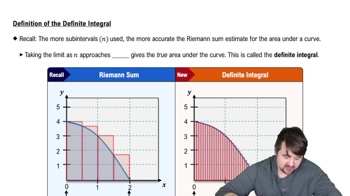
A definite integral represents the net area between the graph of a function and the x-axis over a given interval. Areas above the x-axis contribute positively, while areas below contribute negatively, affecting the integral's value.
Recommended video:
05:43
Definition of the Definite Integral

Interpreting Graphical Areas

When evaluating integrals from graphs, it is essential to identify and measure the areas of regions bounded by the curve and the x-axis. Understanding which parts lie above or below the axis helps determine the sign and magnitude of each area.
Recommended video:
05:06
Finding Area When Bounds Are Not Given

Properties of Definite Integrals

Definite integrals are additive over adjacent intervals, meaning the integral from a to c can be split into integrals over subintervals. This property allows summing individual areas to find the total integral value.
Recommended video:
05:43
Definition of the Definite Integral
Related Practice
Textbook Question

Use geometry and properties of integrals to evaluate


βˆ«β‚€ΒΉ (2𝓍 + √(1―𝓍²) + 1) d𝓍

Textbook Question

Definite integrals Evaluate the following integrals using the Fundamental Theorem of Calculus. Sketch the graph of the integrand and shade the region whose net area you have found.                       


 βˆ«β‚€β΅ (𝓍²―9) d𝓍 

Textbook Question

Indefinite integrals Use a change of variables or Table 5.6 to evaluate the following indefinite integrals. Check your work by differentiating.                                                                                  


 βˆ« 𝓍eΛ£Β² d𝓍

Textbook Question

Areas of regions Find the area of the following regions.                                                                                                                   

                                                                                                                                                                 The region bounded by the graph of Ζ’(𝓍) = x /√(𝓍² ―9) and the 𝓍-axis between and 𝓍 = 4 and π“= 5

1
views
Textbook Question

Indefinite integrals Use a change of variables or Table 5.6 to evaluate the following indefinite integrals. Check your work by differentiating.                                                                                  


 βˆ« 2𝓍(𝓍² ― 1)⁹⁹ d𝓍

Textbook Question

Average velocity The velocity in m/s of an object moving along a line over the time interval [0,6] is v (t) = tΒ² + 3t. Find the average velocity of the object over this time interval.