Ch. 5 - Integration
Briggs - Calculus: Early Transcendentals 3rd Edition
Briggs3rd EditionCalculus: Early TranscendentalsISBN: 9780136847243Not the one you use?Change textbook
Chapter 5, Problem 5.4.35

Average velocity The velocity in m/s of an object moving along a line over the time interval [0,6] is v (t) = t² + 3t. Find the average velocity of the object over this time interval.

Verified step by step guidance
1
Step 1: Recall the formula for average velocity over a time interval [a, b]. It is given by: vavg=1b-aab
Step 2: Substitute the given time interval [0, 6] into the formula. The average velocity becomes: vavg=16-006
Step 3: Write the integral expression for the velocity function v(t) = t² + 3t. The integral becomes: 06(t²+3t)dt
Step 4: Compute the integral of the function t² + 3t. Use the power rule for integration: dt=3 and 3tdt=3t²2. Combine these results to find the antiderivative.
Step 5: Evaluate the definite integral by substituting the limits of integration (0 and 6) into the antiderivative. Then divide the result by the length of the interval (6 - 0) to find the average velocity.

Verified video answer for a similar problem:

This video solution was recommended by our tutors as helpful for the problem above.
Video duration:
4m
Was this helpful?

Key Concepts

Here are the essential concepts you must grasp in order to answer the question correctly.

Average Velocity

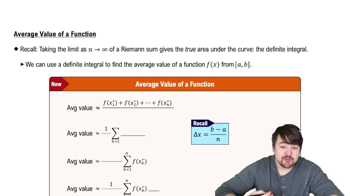
Average velocity is defined as the total displacement divided by the total time taken. In calculus, it can be calculated using the formula: average velocity = (s(b) - s(a)) / (b - a), where s(t) is the position function and [a, b] is the time interval. For the given problem, we need to integrate the velocity function over the interval and then divide by the length of the interval.
Recommended video:
06:37
Average Value of a Function

Velocity Function

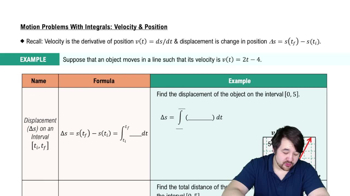
The velocity function describes how the velocity of an object changes over time. In this case, the velocity is given by v(t) = t² + 3t, which is a polynomial function. Understanding this function is crucial for determining the object's behavior over the specified time interval, as it provides the rate of change of position with respect to time.
Recommended video:
10:17
Using The Velocity Function

Integration

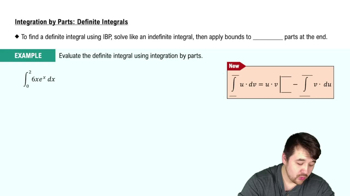
Integration is a fundamental concept in calculus used to find the area under a curve, which in the context of motion, represents the total displacement. To find the average velocity, we need to integrate the velocity function v(t) over the interval [0, 6] and then divide the result by the length of the interval. This process allows us to calculate the total change in position over the given time period.
Recommended video:
06:18
Integration by Parts for Definite Integrals
Related Practice
Textbook Question

Areas of regions Find the area of the following regions.                                                                                                                   

                                                                                                                                                                 The region bounded by the graph of ƒ(𝓍) = x /√(𝓍² ―9) and the 𝓍-axis between and 𝓍 = 4 and 𝓍= 5

1
views

Textbook Question

Indefinite integrals Use a change of variables or Table 5.6 to evaluate the following indefinite integrals. Check your work by differentiating.                                                                                  


 ∫ 2𝓍(𝓍² ― 1)⁹⁹ d𝓍

Textbook Question

Indefinite integrals Use a change of variables or Table 5.6 to evaluate the following indefinite integrals. Check your work by differentiating.                                                                                  


 ∫ [ 1/(10𝓍―3) d𝓍

Textbook Question

Multiple substitutions If necessary, use two or more substitutions to find the following integrals.                                                                                    


  ∫₀^π/² (cos θ sin θ) / √(cos² θ + 16) dθ (Hint: Begin with u = cos θ .)

1
views
Textbook Question

Explain why ∫ₐᵇ ƒ ′(𝓍) d𝓍 = ƒ(b) ― ƒ(a)

Textbook Question

Definite integrals from graphs The figure shows the areas of regions bounded by the graph of ƒ and the 𝓍-axis. Evaluate the following integrals.


∫ₐᶜ ƒ(𝓍) d𝓍

1
views