Ch. 5 - Integration
Briggs - Calculus: Early Transcendentals 3rd Edition
Briggs3rd EditionCalculus: Early TranscendentalsISBN: 9780136847243Not the one you use?Change textbook
Chapter 5, Problem 5.5.96

Areas of regions Find the area of the following regions.                                                                                                                   
                                                                                                                                                                 The region bounded by the graph of Ζ’(𝓍) = x /√(𝓍² ―9) and the 𝓍-axis between and 𝓍 = 4 and π“= 5

Verified step by step guidance
1
Identify the function and the interval: The function given is \(f(x) = \frac{x}{\sqrt{x^{2} - 9}}\), and the region is bounded by this curve and the x-axis between \(x=4\) and \(x=5\).
Determine the points where the function intersects the x-axis: Since the function involves a square root in the denominator, check the domain. The expression under the square root, \(x^{2} - 9\), must be positive, so \(|x| > 3\). The interval \([4,5]\) is valid. Also, note that the function is positive or negative in this interval to understand the area calculation.
Set up the definite integral for the area: The area between the curve and the x-axis from \(x=4\) to \(x=5\) is given by the integral \(A = \int_{4}^{5} \left| \frac{x}{\sqrt{x^{2} - 9}} \right| \, dx\). Since the function is positive in this interval, the absolute value can be removed.
Simplify the integral if possible: Consider a substitution to evaluate the integral. For example, let \(u = x^{2} - 9\), then \(du = 2x \, dx\), which can help rewrite the integral in terms of \(u\).
Express the integral in terms of \(u\) and set the new limits: When \(x=4\), \(u = 4^{2} - 9 = 16 - 9 = 7\), and when \(x=5\), \(u = 25 - 9 = 16\). Rewrite the integral accordingly and prepare to integrate with respect to \(u\).

Verified video answer for a similar problem:

This video solution was recommended by our tutors as helpful for the problem above.
Video duration:
4m
Was this helpful?

Key Concepts

Here are the essential concepts you must grasp in order to answer the question correctly.

Definite Integral for Area Calculation

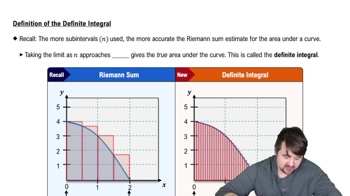
The definite integral of a function between two points gives the net area between the curve and the x-axis over that interval. When the function is positive, the integral represents the area under the curve. To find the area of a region bounded by a curve and the x-axis, you evaluate the definite integral of the function from the lower to the upper limit.
Recommended video:
05:43
Definition of the Definite Integral

Domain and Behavior of the Function

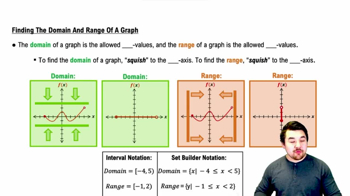
Understanding the domain of the function f(x) = x / √(x² - 9) is crucial because the expression under the square root must be positive, so x² - 9 > 0, implying |x| > 3. This ensures the function is real-valued and continuous on the interval [4,5]. Recognizing this helps avoid invalid integration limits and ensures the integral is well-defined.
Recommended video:
5:10
Finding the Domain and Range of a Graph

Handling Functions with Square Roots in the Denominator

Functions with square roots in the denominator often require algebraic manipulation or substitution to integrate effectively. For f(x) = x / √(x² - 9), a common technique is to use a trigonometric or hyperbolic substitution to simplify the integral. This approach transforms the integral into a more manageable form, facilitating the calculation of the area.
Recommended video:
06:11
Limits of Rational Functions: Denominator = 0
Related Practice
Textbook Question

Use geometry and properties of integrals to evaluate


βˆ«β‚€ΒΉ (2𝓍 + √(1―𝓍²) + 1) d𝓍

Textbook Question

Indefinite integrals Use a change of variables or Table 5.6 to evaluate the following indefinite integrals. Check your work by differentiating.                                                                                  


 βˆ« 𝓍eΛ£Β² d𝓍

Textbook Question

Indefinite integrals Use a change of variables or Table 5.6 to evaluate the following indefinite integrals. Check your work by differentiating.                                                                                  


 βˆ« 2𝓍(𝓍² ― 1)⁹⁹ d𝓍

Textbook Question

Indefinite integrals Use a change of variables or Table 5.6 to evaluate the following indefinite integrals. Check your work by differentiating.                                                                                  


 βˆ« [ 1/(10𝓍―3) d𝓍

Textbook Question

Average velocity The velocity in m/s of an object moving along a line over the time interval [0,6] is v (t) = tΒ² + 3t. Find the average velocity of the object over this time interval.

Textbook Question

Definite integrals from graphs The figure shows the areas of regions bounded by the graph of Ζ’ and the 𝓍-axis. Evaluate the following integrals.


βˆ«β‚αΆœ Ζ’(𝓍) d𝓍

1
views