
Cylinder and cones (Putnam Exam 1938) Right circular cones of height h and radius r are attached to each end of a right circular cylinder of height h and radius r, forming a double-pointed object. For a given surface area A, what are the dimensions r and h that maximize the volume of the object?
Verify that the following functions satisfy the conditions of Theorem 4.9 on their domains. Then find the location and value of the absolute extrema guaranteed by the theorem.
f(x) = x√(3-x)
Verified step by step guidance
Verified video answer for a similar problem:
Key Concepts
Theorem 4.9 (Extreme Value Theorem)
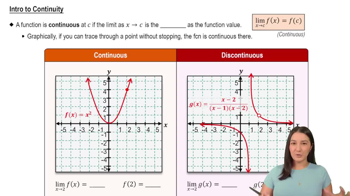
Continuity of Functions
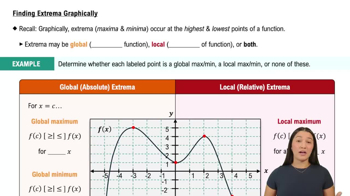
Finding Extrema
49–54. {Use of Tech} Graphing with technology Make a complete graph of the following functions. A graphing utility is useful in locating intercepts, local extreme values, and inflection points.
ƒ(x) = 1/3 x³ - 2x² - 5x + 2
Second Derivative Test Locate the critical points of the following functions. Then use the Second Derivative Test to determine (if possible) whether they correspond to local maxima or local minima.
f(x) = x³ - (3/2)x² - 36x
23–68. Indefinite integrals Determine the following indefinite integrals. Check your work by differentiation.
∫ (sec² Θ + sec Θ tan Θ)dΘ
Evaluate the following limits. Use l’Hôpital’s Rule when it is convenient and applicable.
lim_x→ e (ln x - 1) / (x - 1)
Locating critical points Find the critical points of the following functions. Assume a is a nonzero constant.
ƒ(x) = eˣ + e⁻ˣ
