Ch. 4 - Applications of the Derivative
Briggs - Calculus: Early Transcendentals 3rd Edition
Briggs3rd EditionCalculus: Early TranscendentalsISBN: 9780136847243Not the one you use?Change textbook
Chapter 4, Problem 4.9.45

23–68. Indefinite integrals Determine the following indefinite integrals. Check your work by differentiation.


∫ (sec² Θ + sec Θ tan Θ)dΘ

Verified step by step guidance
1
Rewrite the integral as the sum of two separate integrals: ∫(sec²Θ)dΘ + ∫(secΘ tanΘ)dΘ. This is possible because the integral of a sum is the sum of the integrals.
Recognize the standard integral formulas: ∫(sec²Θ)dΘ = tanΘ + C₁ and ∫(secΘ tanΘ)dΘ = secΘ + C₂, where C₁ and C₂ are constants of integration.
Combine the results of the two integrals: tanΘ + secΘ + C, where C is the combined constant of integration (C = C₁ + C₂).
Verify your solution by differentiating the result, tanΘ + secΘ + C. Use the derivative rules: d/dΘ(tanΘ) = sec²Θ and d/dΘ(secΘ) = secΘ tanΘ.
Check that the derivative of tanΘ + secΘ + C matches the original integrand, sec²Θ + secΘ tanΘ. If it does, your solution is correct.

Verified video answer for a similar problem:

This video solution was recommended by our tutors as helpful for the problem above.
Video duration:
1m
Was this helpful?

Key Concepts

Here are the essential concepts you must grasp in order to answer the question correctly.

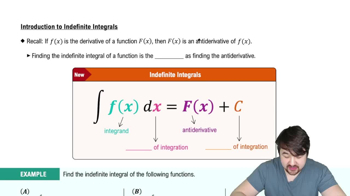
Indefinite Integrals

Indefinite integrals represent a family of functions whose derivative is the integrand. They are expressed without limits and include a constant of integration, typically denoted as 'C'. The process of finding an indefinite integral is known as integration, which is the reverse operation of differentiation.
Recommended video:
05:04
Introduction to Indefinite Integrals

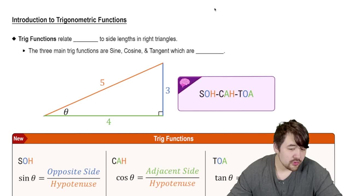
Trigonometric Functions

Trigonometric functions, such as secant (sec) and tangent (tan), are fundamental in calculus, particularly in integration and differentiation. The secant function is defined as the reciprocal of the cosine function, while the tangent function is the ratio of sine to cosine. Understanding their derivatives and integrals is crucial for solving problems involving these functions.
Recommended video:
6:04
Introduction to Trigonometric Functions

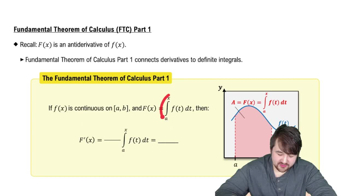
Fundamental Theorem of Calculus

The Fundamental Theorem of Calculus links differentiation and integration, stating that if a function is continuous on an interval, then the integral of its derivative over that interval equals the change in the function's values. This theorem is essential for verifying the correctness of indefinite integrals by differentiating the result to check if it matches the original integrand.
Recommended video:
06:11
Fundamental Theorem of Calculus Part 1
Related Practice
Textbook Question

Second Derivative Test Locate the critical points of the following functions. Then use the Second Derivative Test to determine (if possible) whether they correspond to local maxima or local minima.


f(x) = x³ - (3/2)x² - 36x

2
views

Textbook Question

Verify that the following functions satisfy the conditions of Theorem 4.9 on their domains. Then find the location and value of the absolute extrema guaranteed by the theorem.


f(x) = x√(3-x)

1
views
Textbook Question

Evaluate the following limits. Use l’Hôpital’s Rule when it is convenient and applicable.

lim_x→ e (ln x - 1) / (x - 1)

1
views
Textbook Question

Given a function f that is differentiable on its domain, write and explain the relationship between the differentials dx and dy.

Textbook Question

Avalanche forecasting Avalanche forecasters measure the temperature gradient dT/dh, which is the rate at which the temperature in a snowpack T changes with respect to its depth h. A large temperature gradient may lead to a weak layer in the snowpack. When these weak layers collapse, avalanches occur. Avalanche forecasters use the following rule of thumb: If dT/dh exceeds 10° C/m anywhere in the snowpack, conditions are favorable for weak-layer formation, and the risk of avalanche increases. Assume the temperature function is continuous and differentiable.


a. An avalanche forecaster digs a snow pit and takes two temperature measurements. At the surface (h = 0), the temperature is -16° C. At a depth of 1.1 m, the temperature is -2° C. Using the Mean Value Theorem, what can he conclude about the temperature gradient? Is the formation of a weak layer likely?

Textbook Question

Locating critical points Find the critical points of the following functions. Assume a is a nonzero constant.


ƒ(x) = eˣ + e⁻ˣ