
Ch. 4 - Applications of the Derivative
Briggs - Calculus: Early Transcendentals 3rd Edition
Briggs3rd EditionCalculus: Early TranscendentalsISBN: 9780136847243Not the one you use?Change textbook
Chapter 4, Problem 4.1.31

Locating critical points Find the critical points of the following functions. Assume a is a nonzero constant.


ƒ(t) = t/ t² + 1

Verified step by step guidance
1
To find the critical points of the function \( f(t) = \frac{t}{t^2 + 1} \), we first need to find its derivative \( f'(t) \).
Use the quotient rule for differentiation, which states that if \( f(t) = \frac{u(t)}{v(t)} \), then \( f'(t) = \frac{u'(t)v(t) - u(t)v'(t)}{(v(t))^2} \). Here, \( u(t) = t \) and \( v(t) = t^2 + 1 \).
Calculate \( u'(t) \) and \( v'(t) \). We have \( u'(t) = 1 \) and \( v'(t) = 2t \).
Substitute \( u(t) \), \( v(t) \), \( u'(t) \), and \( v'(t) \) into the quotient rule formula to find \( f'(t) = \frac{(1)(t^2 + 1) - (t)(2t)}{(t^2 + 1)^2} \). Simplify the expression to get \( f'(t) = \frac{1 - t^2}{(t^2 + 1)^2} \).
Set \( f'(t) = 0 \) to find the critical points. This gives \( 1 - t^2 = 0 \). Solve for \( t \) to find the critical points.

Verified video answer for a similar problem:

This video solution was recommended by our tutors as helpful for the problem above.
Video duration:
4m
Was this helpful?

Key Concepts

Here are the essential concepts you must grasp in order to answer the question correctly.

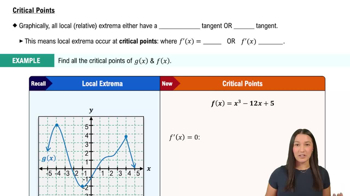
Critical Points

Critical points of a function occur where its derivative is either zero or undefined. These points are essential for identifying local maxima, minima, and points of inflection. To find critical points, one typically differentiates the function and solves for the values of the variable that satisfy these conditions.
Recommended video:
04:50
Critical Points

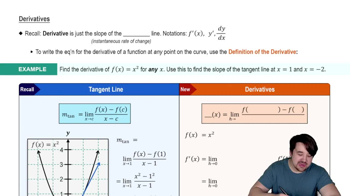
Derivative

The derivative of a function measures the rate at which the function's value changes with respect to changes in its input. It is a fundamental concept in calculus that provides information about the function's slope and behavior. For the function given, finding the derivative will help identify where the critical points are located.
Recommended video:
05:44
Derivatives

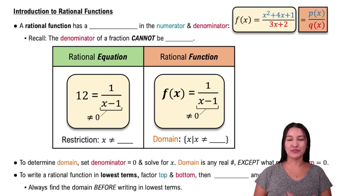
Rational Functions

A rational function is a ratio of two polynomials. In the given function, ƒ(t) = t / (t² + 1), the numerator is a polynomial of degree one, and the denominator is a polynomial of degree two. Understanding the properties of rational functions, such as their domain and behavior at asymptotes, is crucial for analyzing their critical points and overall shape.
Recommended video:
6:04
Intro to Rational Functions
Related Practice
Textbook Question

{Use of Tech} Estimating roots The values of various roots can be approximated using Newton’s method. For example, to approximate the value of ³√10, we let x = ³√10 and cube both sides of the equation to obtain x³ = 10, or x³ - 10 = 0. Therefore, ³√10 is a root of p(x) = x³ - 10, which we can approximate by applying Newton’s method. Approximate each value of r by first finding a polynomial with integer coefficients that has a root r. Use an appropriate value of x₀ and stop calculating approximations when two successive approximations agree to five digits to the right of the decimal point after rounding.


r = 7¹/⁴

Textbook Question

Absolute maxima and minima Determine the location and value of the absolute extreme values of ƒ on the given interval, if they exist.


ƒ(x) = (4x³/3) + 5x² - 6x on [0,5]

1
views
Textbook Question

Increasing and decreasing functions. Find the intervals on which f is increasing and the intervals on which it is decreasing.


f(x) = eˣ/(e²ᵉ + 1)

1
views
Textbook Question

Rectangles beneath a parabola A rectangle is constructed with its base on the x-axis and two of its vertices on the parabola y = 48 - x². What are the dimensions of the rectangle with the maximum area? What is the area?

Textbook Question

A graph of ƒ and the lines tangent to ƒ at x = 1, 2 and 3 are given. If x₀ = 3, find the values of x₁, x₂, and x₃, that are obtained by applying Newton’s method. <IMAGE>

Textbook Question

Acceleration to position Given the following acceleration functions of an object moving along a line, find the position function with the given initial velocity and position.


a(t) = -32; v(0) = 20, s(0) = 0