
Textbook Question
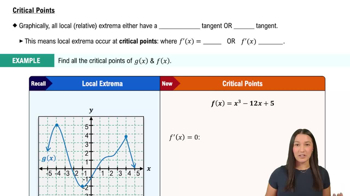
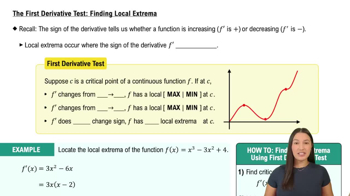
Second Derivative Test Locate the critical points of the following functions. Then use the Second Derivative Test to determine (if possible) whether they correspond to local maxima or local minima.
f(x) = eˣ(x - 2)²
1
views

 Verified step by step guidance
 04:50
04:50
 07:09
07:09 05:59
05:59Second Derivative Test Locate the critical points of the following functions. Then use the Second Derivative Test to determine (if possible) whether they correspond to local maxima or local minima.
f(x) = eˣ(x - 2)²
Locating critical points Find the critical points of the following functions. Assume a is a nonzero constant.
ƒ(x) = 3x³ + 3x² / 2 - 2x
{Use of Tech} Finding roots with Newton’s method For the given function f and initial approximation x₀, use Newton’s method to approximate a root of f. Stop calculating approximations when two successive approximations agree to five digits to the right of the decimal point after rounding. Show your work by making a table similar to that in Example 1.
f(x) = x ln (x + 1) -1 ; x₀ = 1.7
Increasing and decreasing functions. Find the intervals on which f is increasing and the intervals on which it is decreasing.
f(x) = eˣ/(e²ᵉ + 1)
Rectangles beneath a parabola A rectangle is constructed with its base on the x-axis and two of its vertices on the parabola y = 48 - x². What are the dimensions of the rectangle with the maximum area? What is the area?
Locating critical points Find the critical points of the following functions. Assume a is a nonzero constant.
ƒ(t) = t/ t² + 1