
Textbook Question
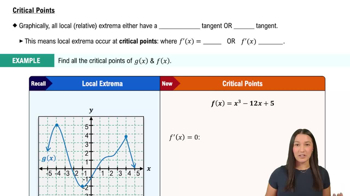
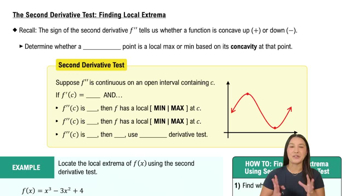
Graphing functions Use the guidelines of this section to make a complete graph of f.
f(x) = e⁻ˣ²/₂

 Verified step by step guidance
 04:50
04:50
 06:02
06:02 6:13
6:13Graphing functions Use the guidelines of this section to make a complete graph of f.
f(x) = e⁻ˣ²/₂
Absolute maxima and minima Determine the location and value of the absolute extreme values of ƒ on the given interval, if they exist.
ƒ(x) = x/(x²+9)⁵ on [-2,2]
{Use of Tech} Finding roots with Newton’s method For the given function f and initial approximation x₀, use Newton’s method to approximate a root of f. Stop calculating approximations when two successive approximations agree to five digits to the right of the decimal point after rounding. Show your work by making a table similar to that in Example 1.
f(x) = x² - 10; x₀ = 3
Locating critical points Find the critical points of the following functions. Assume a is a nonzero constant.
ƒ(x) = 3x³ + 3x² / 2 - 2x
{Use of Tech} Finding roots with Newton’s method For the given function f and initial approximation x₀, use Newton’s method to approximate a root of f. Stop calculating approximations when two successive approximations agree to five digits to the right of the decimal point after rounding. Show your work by making a table similar to that in Example 1.
f(x) = x ln (x + 1) -1 ; x₀ = 1.7
Absolute maxima and minima Determine the location and value of the absolute extreme values of ƒ on the given interval, if they exist.
ƒ(x) = (4x³/3) + 5x² - 6x on [0,5]