Ch. 4 - Applications of the Derivative
Briggs - Calculus: Early Transcendentals 3rd Edition
Briggs3rd EditionCalculus: Early TranscendentalsISBN: 9780136847243Not the one you use?Change textbook
Chapter 4, Problem 4.8.39

{Use of Tech} Estimating roots The values of various roots can be approximated using Newton’s method. For example, to approximate the value of ³√10, we let x = ³√10 and cube both sides of the equation to obtain x³ = 10, or x³ - 10 = 0. Therefore, ³√10 is a root of p(x) = x³ - 10, which we can approximate by applying Newton’s method. Approximate each value of r by first finding a polynomial with integer coefficients that has a root r. Use an appropriate value of x₀ and stop calculating approximations when two successive approximations agree to five digits to the right of the decimal point after rounding.


r = 7¹/⁴

Verified step by step guidance
1
Identify the root to approximate: r = 7^(1/4). This means we are looking for the fourth root of 7.
Express the problem as a polynomial equation: Let x = 7^(1/4). Then, x^4 = 7, which can be rewritten as x^4 - 7 = 0. This is the polynomial p(x) = x^4 - 7.
Apply Newton's method to approximate the root: Newton's method uses the formula x_(n+1) = x_n - (p(x_n) / p'(x_n)), where p'(x) is the derivative of p(x).
Calculate the derivative of the polynomial: For p(x) = x^4 - 7, the derivative p'(x) = 4x^3.
Choose an initial guess x₀: A reasonable starting point might be x₀ = 2, since 2^4 = 16 is close to 7. Use the Newton's method formula iteratively, updating x_n until two successive approximations agree to five decimal places.

Verified video answer for a similar problem:

This video solution was recommended by our tutors as helpful for the problem above.
Video duration:
5m
Was this helpful?

Key Concepts

Here are the essential concepts you must grasp in order to answer the question correctly.

Newton's Method

Newton's method is an iterative numerical technique used to approximate the roots of a real-valued function. It starts with an initial guess and refines this guess using the function's derivative, applying the formula x_{n+1} = x_n - f(x_n)/f'(x_n). This process continues until the approximations converge to a desired level of accuracy, making it particularly useful for functions that are difficult to solve analytically.
Recommended video:
4:26
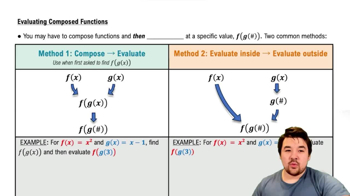
Evaluating Composed Functions

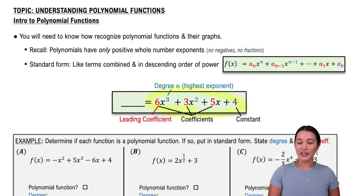
Polynomial Functions

A polynomial function is a mathematical expression involving a sum of powers in one or more variables multiplied by coefficients. In the context of root-finding, the polynomial p(x) = x³ - 10 is used to represent the problem of finding the cube root of 10. Understanding the structure of polynomial functions is essential, as their roots correspond to the values of x that make the polynomial equal to zero.
Recommended video:
6:04
Introduction to Polynomial Functions

Convergence Criteria

Convergence criteria are the conditions under which an iterative method, like Newton's method, is considered to have successfully approximated a solution. In this case, the process stops when two successive approximations agree to five decimal places. This ensures that the approximation is sufficiently accurate for practical purposes, highlighting the importance of precision in numerical methods.
Recommended video:
05:44
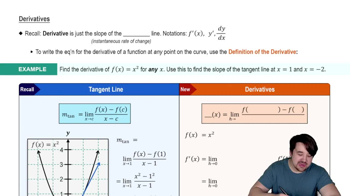
Derivatives