Ch. 4 - Applications of the Derivative
Briggs - Calculus: Early Transcendentals 3rd Edition
Briggs3rd EditionCalculus: Early TranscendentalsISBN: 9780136847243Not the one you use?Change textbook
Chapter 4, Problem 4.R.49

Change in elevation The elevation h (in feet above the ground) of a stone dropped from a height of 1000 ft is modeled by the equation h(t) = 1000 - 16t², where t is measured in seconds and air resistance is neglected. Approximate the change in elevation over the interval 5 ≤ t ≤ 5.7 (recall that Δh ≈ h' (a) Δt).

Verified step by step guidance
1
Identify the function that models the elevation: h(t) = 1000 - 16t².
Determine the derivative of the function h(t) with respect to t to find h'(t). The derivative h'(t) represents the rate of change of elevation with respect to time.
Calculate h'(t) by differentiating h(t) = 1000 - 16t². The derivative is h'(t) = -32t.
Choose a point 'a' within the interval 5 ≤ t ≤ 5.7 to approximate the change in elevation. A common choice is the midpoint of the interval, t = 5.35.
Use the formula Δh ≈ h'(a) Δt to approximate the change in elevation, where Δt = 5.7 - 5. Substitute a = 5.35 and Δt = 0.7 into the formula to find the approximate change in elevation.

Verified video answer for a similar problem:

This video solution was recommended by our tutors as helpful for the problem above.
Video duration:
3m
Was this helpful?

Key Concepts

Here are the essential concepts you must grasp in order to answer the question correctly.

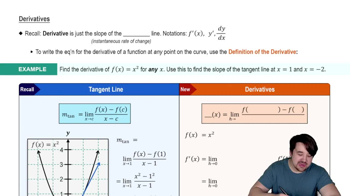
Derivative

The derivative of a function measures the rate at which the function's value changes as its input changes. In this context, h'(t) represents the instantaneous rate of change of elevation with respect to time, which is crucial for understanding how quickly the stone is falling at any given moment.
Recommended video:
05:44
Derivatives

Change in Function Value

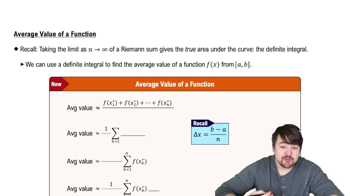
The change in function value, denoted as Δh, refers to the difference in the function's output over a specified interval. In this case, it represents the change in elevation of the stone as time progresses from t = 5 to t = 5.7 seconds, which can be approximated using the derivative and the change in time, Δt.
Recommended video:
06:37
Average Value of a Function

Interval Notation

Interval notation is a mathematical notation used to represent a range of values. Here, the interval 5 ≤ t ≤ 5.7 indicates the specific time frame during which we are analyzing the stone's elevation, allowing us to focus on the behavior of the function h(t) within that range.
Recommended video:
04:22
Sigma Notation