Ch. 4 - Applications of the Derivative
Briggs - Calculus: Early Transcendentals 3rd Edition
Briggs3rd EditionCalculus: Early TranscendentalsISBN: 9780136847243Not the one you use?Change textbook
Chapter 4, Problem 4.R.31

24–34. Curve sketching Use the guidelines given in Section 4.4 to make a complete graph of the following functions on their domains or on the given interval. Use a graphing utility to check your work.
ƒ(x) = 10x² / (x² + 3)

Verified step by step guidance
1
Identify the domain of the function. Since the function is a rational function, it is defined for all real numbers except where the denominator is zero. Here, the denominator \(x^2 + 3\) is never zero, so the domain is all real numbers.
Find the intercepts. For the y-intercept, set \(x = 0\) and solve \(f(0) = \frac{10(0)^2}{0^2 + 3} = 0\). For x-intercepts, set \(f(x) = 0\) and solve \(10x^2 = 0\), which gives \(x = 0\). Thus, the only intercept is at the origin (0,0).
Determine the asymptotic behavior. Since the degree of the numerator and denominator are the same, the horizontal asymptote is given by the ratio of the leading coefficients, \(y = \frac{10}{1} = 10\). There are no vertical asymptotes as the denominator is never zero.
Analyze the first derivative \(f'(x)\) to find critical points and determine intervals of increase and decrease. Use the quotient rule: \(f'(x) = \frac{d}{dx}\left(\frac{10x^2}{x^2 + 3}\right)\). Simplify and solve \(f'(x) = 0\) to find critical points.
Examine the second derivative \(f''(x)\) to determine concavity and points of inflection. Use the derivative of \(f'(x)\) and solve \(f''(x) = 0\) to find points of inflection. Analyze the sign of \(f''(x)\) to determine concavity on intervals.

Verified video answer for a similar problem:

This video solution was recommended by our tutors as helpful for the problem above.
Video duration:
13m
Was this helpful?

Key Concepts

Here are the essential concepts you must grasp in order to answer the question correctly.

Function Behavior

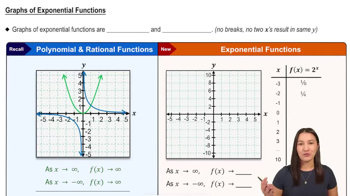
Understanding the behavior of the function involves analyzing its limits, continuity, and asymptotic behavior. For the given function, ƒ(x) = 10x² / (x² + 3), it's essential to determine how the function behaves as x approaches positive and negative infinity, as well as any critical points where the function may change direction.
Recommended video:
5:46
Graphs of Exponential Functions

Critical Points and Derivatives

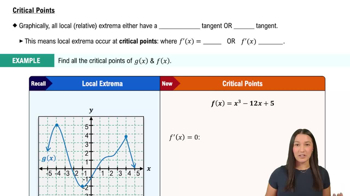
Critical points are found by taking the derivative of the function and setting it to zero. This helps identify local maxima and minima, which are crucial for sketching the graph accurately. For ƒ(x), calculating the derivative will reveal where the slope of the tangent is zero, indicating potential peaks or troughs in the graph.
Recommended video:
04:50
Critical Points

Graphing Techniques

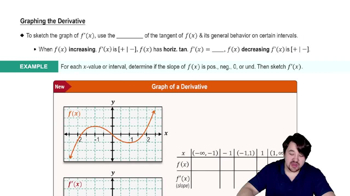
Graphing techniques involve plotting key features of the function, such as intercepts, critical points, and asymptotes. For ƒ(x), identifying the y-intercept (when x=0) and the x-intercepts (where ƒ(x)=0) will provide anchor points for the graph. Additionally, understanding the end behavior and any horizontal or vertical asymptotes will help in creating a complete and accurate sketch.
Recommended video:
06:15
Graphing The Derivative
Related Practice
Textbook Question

90–103. Indefinite integrals Determine the following indefinite integrals.


∫ ((1/x²) - (2/(x⁵⸍²))) dx

Textbook Question

90–103. Indefinite integrals Determine the following indefinite integrals.


∫ (2x +1)² dx

Textbook Question

Optimal popcorn box A small popcorn box is created from a 12" x 12" sheet of paperboard by first cutting out four shaded rectangles, each of length x and width x/2 (see figure). The remaining paperboard is folded along the solid lines to form a box. What dimensions of the box maximize the volume of the box? <IMAGE>

Textbook Question

Minimum painting surface A metal cistern in the shape of a right circular cylinder with volume V = 50 m³ needs to be painted each year to reduce corrosion. The paint is applied only to surfaces exposed to the elements (the outside cylinder wall and the circular top). Find the dimensions r and h of the cylinder that minimize the area of the painted surfaces.

Textbook Question

Change in elevation The elevation h (in feet above the ground) of a stone dropped from a height of 1000 ft is modeled by the equation h(t) = 1000 - 16t², where t is measured in seconds and air resistance is neglected. Approximate the change in elevation over the interval 5 ≤ t ≤ 5.7 (recall that Δh ≈ h' (a) Δt).

Textbook Question

24–34. Curve sketching Use the guidelines given in Section 4.4 to make a complete graph of the following functions on their domains or on the given interval. Use a graphing utility to check your work.


ƒ(x) = 4cos (π (x-1)) on [0, 2]