Ch. 4 - Applications of the Derivative
Briggs - Calculus: Early Transcendentals 3rd Edition
Briggs3rd EditionCalculus: Early TranscendentalsISBN: 9780136847243Not the one you use?Change textbook
Chapter 4, Problem 4.R.99

90–103. Indefinite integrals Determine the following indefinite integrals.


∫ (12/x)dx

Verified step by step guidance
1
Step 1: Recognize that the integral ∫ (12/x) dx involves a basic logarithmic rule. Recall that the integral of 1/x with respect to x is ln|x|.
Step 2: Factor out the constant 12 from the integral. This simplifies the expression to 12 ∫ (1/x) dx.
Step 3: Apply the logarithmic integration rule. The integral of 1/x dx is ln|x|, so the expression becomes 12 ln|x|.
Step 4: Add the constant of integration, C, to account for the indefinite nature of the integral. The result is 12 ln|x| + C.
Step 5: Verify the result by differentiating 12 ln|x| + C. The derivative of ln|x| is 1/x, and multiplying by 12 gives back the original integrand, confirming the solution.

Verified video answer for a similar problem:

This video solution was recommended by our tutors as helpful for the problem above.
Video duration:
56s
Was this helpful?

Key Concepts

Here are the essential concepts you must grasp in order to answer the question correctly.

Indefinite Integral

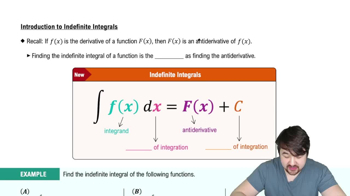
An indefinite integral represents a family of functions whose derivative is the integrand. It is expressed without specific limits and includes a constant of integration, typically denoted as 'C'. The process of finding an indefinite integral is often referred to as antiderivation.
Recommended video:
05:04
Introduction to Indefinite Integrals

Integration of Rational Functions

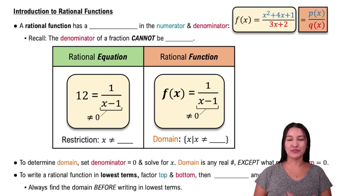
Rational functions are ratios of polynomials. To integrate a rational function, one often uses techniques such as substitution or partial fraction decomposition. In the case of the integral ∫ (12/x)dx, recognizing that this is a simple rational function allows for straightforward integration using the natural logarithm.
Recommended video:
6:04
Intro to Rational Functions

Natural Logarithm

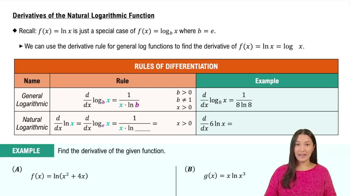
The natural logarithm, denoted as ln(x), is the logarithm to the base 'e', where 'e' is approximately 2.71828. It is particularly important in calculus because the derivative of ln(x) is 1/x, making it a key function when integrating expressions involving 1/x, such as in the integral ∫ (12/x)dx.
Recommended video:
05:18
Derivative of the Natural Logarithmic Function