Ch. 3 - Derivatives
Briggs - Calculus: Early Transcendentals 3rd Edition
Briggs3rd EditionCalculus: Early TranscendentalsISBN: 9780136847243Not the one you use?Change textbook
Chapter 3, Problem 3.2.20b

Use the graph of g in the figure to do the following. <IMAGE>
b. Find the values of x in (-2,2) at which g is not differentiable.

Verified step by step guidance
1
Step 1: Understand the concept of differentiability. A function is differentiable at a point if it has a defined derivative at that point, which means the function must be continuous and smooth (no sharp corners or cusps) at that point.
Step 2: Examine the graph of the function g(x) over the interval (-2, 2). Look for points where the graph has sharp corners, cusps, or vertical tangents, as these are common places where a function is not differentiable.
Step 3: Identify any points of discontinuity within the interval (-2, 2). A function is not differentiable at any point where it is not continuous.
Step 4: Check for any vertical tangents within the interval. A vertical tangent occurs when the slope of the tangent line is undefined, which means the derivative does not exist at that point.
Step 5: List all the x-values within the interval (-2, 2) where the function g(x) is not differentiable based on the observations from the graph.

Verified video answer for a similar problem:

This video solution was recommended by our tutors as helpful for the problem above.
Video duration:
6m
Was this helpful?

Key Concepts

Here are the essential concepts you must grasp in order to answer the question correctly.

Differentiability

A function is differentiable at a point if it has a defined derivative there, meaning the function must be continuous and have a well-defined tangent line at that point. If a function has a sharp corner, cusp, or vertical tangent, it is not differentiable at that point, even if it is continuous.
Recommended video:
05:53
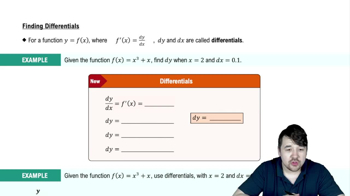
Finding Differentials

Continuity

A function is continuous at a point if the limit of the function as it approaches that point equals the function's value at that point. For differentiability, continuity is a necessary condition; however, continuity alone does not guarantee differentiability.
Recommended video:
05:34
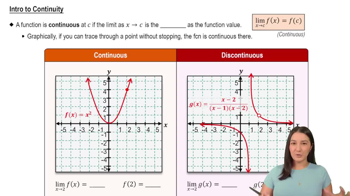
Intro to Continuity

Critical Points

Critical points are values of x where the derivative of a function is either zero or undefined. These points are essential for analyzing the behavior of the function, including identifying where it may not be differentiable, such as at corners or discontinuities.
Recommended video:
04:50
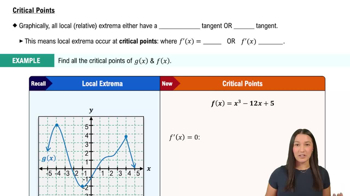
Critical Points
Related Practice
Textbook Question

45–50. Tangent lines Carry out the following steps. <IMAGE>

b. Determine an equation of the line tangent to the curve at the given point.

x³+y³=2xy; (1, 1)

Textbook Question

Velocity of a car The graph shows the position s=f(t) of a car t hours after 5:00 P.M. relative to its starting point s=0,where s is measured in miles. <IMAGE>

b. At approximately what time is the car traveling the fastest? The slowest?

Textbook Question

Explain why or why not Determine whether the following statements are true and give an explanation or counterexample.

b. d/dx(tan^−1 x) =sec² x

Textbook Question

The energy (in joules) released by an earthquake of magnitude M is given by the equation E=25,000 ⋅ 101.5M. (This equation can be solved for M to define the magnitude of a given earthquake; it is a refinement of the original Richter scale created by Charles Richter in 1935.)

Compute dE/dM and evaluate it for M=3. What does this derivative mean? (M has no units, so the units of the derivative are J per change in magnitude.)

Textbook Question

109-112 {Use of Tech} Calculating limits The following limits are the derivatives of a composite function g at a point a.

b. Use the Chain Rule to find each limit. Verify your answer by using a calculator.

limx04+sin(x)2x{\(\displaystyle\]\lim\)_{x\(\to\)0}}\(\frac{\sqrt{4+\sin\left(x\right)}\)-2}{x}

Textbook Question

{Use of Tech} Computing limits with angles in degrees Suppose your graphing calculator has two functions, one called sin x, which calculates the sine of x when x is in radians, and the other called s(x), which calculates the sine of x when x is in degrees.

b. Evaluate lim x→0 s(x) / x. Verify your answer by estimating the limit on your calculator.