
Ch. 3 - Derivatives
Briggs - Calculus: Early Transcendentals 3rd Edition
Briggs3rd EditionCalculus: Early TranscendentalsISBN: 9780136847243Not the one you use?Change textbook
Chapter 3, Problem 3.5.75b

Use a graphing utility to plot the curve and the tangent line.
y = cos x / 1−cos x; x = π/3

Verified step by step guidance
1
First, understand the function y = \( \frac{\cos x}{1 - \cos x} \). This is a rational function where the numerator is \( \cos x \) and the denominator is \( 1 - \cos x \).
Next, find the derivative of the function to determine the slope of the tangent line at \( x = \frac{\pi}{3} \). Use the quotient rule: \( \frac{d}{dx} \left( \frac{u}{v} \right) = \frac{u'v - uv'}{v^2} \), where \( u = \cos x \) and \( v = 1 - \cos x \).
Calculate \( u' \) and \( v' \). For \( u = \cos x \), \( u' = -\sin x \). For \( v = 1 - \cos x \), \( v' = \sin x \). Substitute these into the quotient rule formula.
Evaluate the derivative at \( x = \frac{\pi}{3} \) to find the slope of the tangent line. Substitute \( x = \frac{\pi}{3} \) into the derivative expression you obtained.
Finally, use the point-slope form of the equation of a line, \( y - y_1 = m(x - x_1) \), where \( m \) is the slope found in the previous step, and \( (x_1, y_1) \) is the point on the curve at \( x = \frac{\pi}{3} \). Plot the curve and the tangent line using a graphing utility.

Verified video answer for a similar problem:

This video solution was recommended by our tutors as helpful for the problem above.
Video duration:
5m
Was this helpful?

Key Concepts

Here are the essential concepts you must grasp in order to answer the question correctly.

Tangent Line

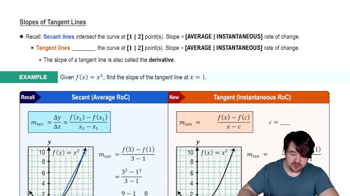
A tangent line to a curve at a given point is a straight line that touches the curve at that point and has the same slope as the curve at that point. It represents the instantaneous rate of change of the function at that specific location. To find the equation of the tangent line, one typically needs the derivative of the function evaluated at the point of tangency.
Recommended video:
05:13
Slopes of Tangent Lines

Derivative

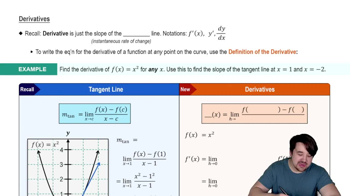
The derivative of a function measures how the function's output value changes as its input value changes. It is defined as the limit of the average rate of change of the function over an interval as the interval approaches zero. In practical terms, the derivative provides the slope of the tangent line to the curve at any given point, which is essential for analyzing the behavior of the function.
Recommended video:
05:44
Derivatives

Graphing Utility

A graphing utility is a software tool or calculator that allows users to visualize mathematical functions and their properties. It can plot curves, compute derivatives, and display tangent lines, making it easier to analyze complex functions. Using a graphing utility helps in understanding the relationship between a function and its tangent line, especially at specific points like x = π/3.
Recommended video:
06:15
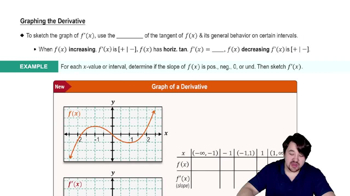
Graphing The Derivative
Related Practice
Textbook Question

97–100. Logistic growth Scientists often use the logistic growth function P(t) = P₀K / P₀+(K−P₀)e^−r₀t to model population growth, where P₀ is the initial population at time t=0, K is the carrying capacity, and r₀ is the base growth rate. The carrying capacity is a theoretical upper bound on the total population that the surrounding environment can support. The figure shows the sigmoid (S-shaped) curve associated with a typical logistic model. <IMAGE>


{Use of Tech} Gone fishing When a reservoir is created by a new dam, 50 fish are introduced into the reservoir, which has an estimated carrying capacity of 8000 fish. A logistic model of the fish population is P(t) = 400,000 / 50+7950e^−0.5t, where t is measured in years.


b. How long does it take for the population to reach 5000 fish? How long does it take for the population to reach 90% of the carrying capacity?

Textbook Question

Velocity of a car The graph shows the position s=f(t) of a car t hours after 5:00 P.M. relative to its starting point s=0,where s is measured in miles. <IMAGE>

b. At approximately what time is the car traveling the fastest? The slowest?

Textbook Question

The energy (in joules) released by an earthquake of magnitude M is given by the equation E=25,000 ⋅ 101.5M. (This equation can be solved for M to define the magnitude of a given earthquake; it is a refinement of the original Richter scale created by Charles Richter in 1935.)

Compute dE/dM and evaluate it for M=3. What does this derivative mean? (M has no units, so the units of the derivative are J per change in magnitude.)

Textbook Question

Consider the following cost functions.

b. Determine the average cost and the marginal cost when x=a.

C(x) = − 0.01x²+40x+100, 0≤x≤1500, a=1000

Textbook Question

109-112 {Use of Tech} Calculating limits The following limits are the derivatives of a composite function g at a point a.

b. Use the Chain Rule to find each limit. Verify your answer by using a calculator.

limx04+sin(x)2x{\(\displaystyle\]\lim\)_{x\(\to\)0}}\(\frac{\sqrt{4+\sin\left(x\right)}\)-2}{x}

Textbook Question

45–50. Tangent lines Carry out the following steps. <IMAGE>

b. Determine an equation of the line tangent to the curve at the given point.

x⁴-x²y+y⁴=1; (−1, 1)

1
views