
Ch. 3 - Derivatives
Briggs - Calculus: Early Transcendentals 3rd Edition
Briggs3rd EditionCalculus: Early TranscendentalsISBN: 9780136847243Not the one you use?Change textbook
Chapter 3, Problem 23d

Throwing a stone Suppose a stone is thrown vertically upward from the edge of a cliff on Earth with an initial velocity of 32 ft/s from a height of 48 ft above the ground. The height (in feet) of the stone above the ground t seconds after it is thrown is s(t)=16t2+32t+48s(t)=-16t^2+32t+48 .
d. When does the stone strike the ground?

Verified step by step guidance
1
Identify the height function: \( s(t) = -16t^2 + 32t + 48 \).
Set the height function equal to zero to find when the stone hits the ground: \( -16t^2 + 32t + 48 = 0 \).
Use the quadratic formula \( t = \frac{-b \pm \sqrt{b^2 - 4ac}}{2a} \) to solve for \( t \), where \( a = -16 \), \( b = 32 \), and \( c = 48 \).
Calculate the discriminant \( b^2 - 4ac \) to determine the nature of the roots.
Solve for \( t \) using the quadratic formula to find the time when the stone strikes the ground.

Verified video answer for a similar problem:

This video solution was recommended by our tutors as helpful for the problem above.
Video duration:
6m
Was this helpful?

Key Concepts

Here are the essential concepts you must grasp in order to answer the question correctly.

Quadratic Functions

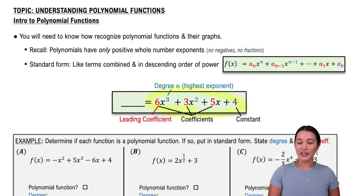
The height of the stone is modeled by a quadratic function, which is a polynomial of degree two. In this case, the function s(t) = -16t² + 32t + 48 represents a parabola that opens downward due to the negative coefficient of t². Understanding the properties of quadratic functions, such as their vertex, axis of symmetry, and roots, is essential for analyzing the motion of the stone.
Recommended video:
6:04
Introduction to Polynomial Functions

Finding Roots

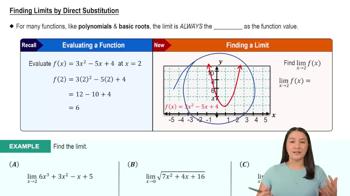
To determine when the stone strikes the ground, we need to find the roots of the quadratic equation, which are the values of t for which s(t) = 0. This involves solving the equation -16t² + 32t + 48 = 0, typically using methods such as factoring, completing the square, or applying the quadratic formula. The roots represent the times at which the height of the stone is zero, indicating it has hit the ground.
Recommended video:
05:21
Finding Limits by Direct Substitution

Projectile Motion

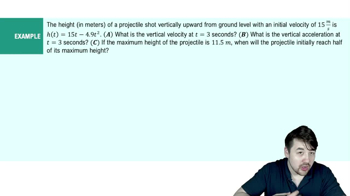
The motion of the stone can be analyzed through the principles of projectile motion, which describes the trajectory of an object under the influence of gravity. In this scenario, the initial velocity and height affect the stone's path. Understanding the effects of gravitational acceleration (approximately -32 ft/s² on Earth) and how it influences the stone's upward and downward motion is crucial for predicting when it will reach the ground.
Recommended video:
06:51
Derivatives Applied To Acceleration Example 2
Related Practice
Textbook Question

Suppose a stone is thrown vertically upward from the edge of a cliff on Earth with an initial velocity of 32 ft/s from a height of 48 ft above the ground. The height (in feet) of the stone above the ground t seconds after it is thrown is s(t) = -16t2 + 32t + 48.

Determine the velocity v of the stone after t seconds.

Textbook Question

Once Kate’s kite reaches a height of 50 ft (above her hands), it rises no higher but drifts due east in a wind blowing 5 ft/s. How fast is the string running through Kate’s hands at the moment when she has released 120 ft of string?

Textbook Question

Suppose a stone is thrown vertically upward from the edge of a cliff on Earth with an initial velocity of 32 ft/s from a height of 48 ft above the ground. The height (in feet) of the stone above the ground t seconds after it is thrown is s(t) = -16t2 + 32t + 48.

On what intervals is the speed increasing?

Textbook Question

Suppose a stone is thrown vertically upward from the edge of a cliff on Earth with an initial velocity of 32 ft/s from a height of 48 ft above the ground. The height (in feet) of the stone above the ground t seconds after it is thrown is s(t) = -16t2 + 32t + 48.

With what velocity does the stone strike the ground?

Textbook Question

5–24. For each of the following composite functions, find an inner function u=g(x) and an outer function y=f(u) such that y=f(g(x)). Then calculate dy/dx.

y = e^√x

Textbook Question

5–24. For each of the following composite functions, find an inner function u=g(x) and an outer function y=f(u) such that y=f(g(x)). Then calculate dy/dx.

y = tan 5x²