
Ch. 3 - Derivatives
Briggs - Calculus: Early Transcendentals 3rd Edition
Briggs3rd EditionCalculus: Early TranscendentalsISBN: 9780136847243Not the one you use?Change textbook
Chapter 3, Problem 23a

Suppose a stone is thrown vertically upward from the edge of a cliff on Earth with an initial velocity of 32 ft/s from a height of 48 ft above the ground. The height (in feet) of the stone above the ground t seconds after it is thrown is s(t) = -16t2 + 32t + 48.
Determine the velocity v of the stone after t seconds.

Verified step by step guidance
1
Step 1: Understand that the velocity of the stone is the derivative of the height function s(t) with respect to time t. This is because velocity is the rate of change of position with respect to time.
Step 2: Write down the height function s(t) = -16t^2 + 32t + 48.
Step 3: Differentiate the height function s(t) with respect to t to find the velocity function v(t). Use the power rule for differentiation: if f(t) = at^n, then f'(t) = n*at^(n-1).
Step 4: Apply the power rule to each term in s(t): the derivative of -16t^2 is -32t, the derivative of 32t is 32, and the derivative of 48 is 0.
Step 5: Combine the derivatives to write the velocity function: v(t) = -32t + 32.

Verified video answer for a similar problem:

This video solution was recommended by our tutors as helpful for the problem above.
Video duration:
3m
Was this helpful?

Key Concepts

Here are the essential concepts you must grasp in order to answer the question correctly.

Velocity

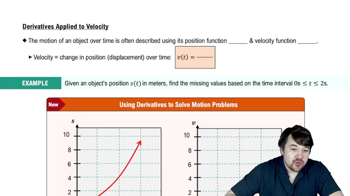
Velocity is the rate of change of an object's position with respect to time. In calculus, it is often represented as the derivative of the position function. For the stone's height function s(t), the velocity v(t) can be found by differentiating s(t) with respect to time t, yielding v(t) = s'(t). This gives insight into how fast the stone is moving at any given moment.
Recommended video:
06:29
Derivatives Applied To Velocity

Derivative

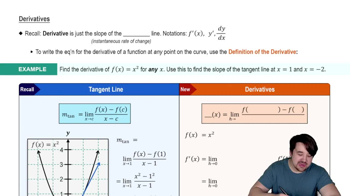
The derivative is a fundamental concept in calculus that measures how a function changes as its input changes. It provides the slope of the tangent line to the function's graph at any point. In this context, taking the derivative of the height function s(t) allows us to calculate the instantaneous velocity of the stone at any time t, which is crucial for understanding its motion.
Recommended video:
05:44
Derivatives

Quadratic Functions

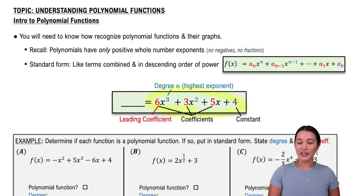
A quadratic function is a polynomial function of degree two, typically expressed in the form f(x) = ax^2 + bx + c. The height function s(t) = -16t^2 + 32t + 48 is a quadratic function, where the coefficient of t^2 indicates the stone's acceleration due to gravity. Understanding the properties of quadratic functions, such as their parabolas and vertex, is essential for analyzing the stone's motion and determining its maximum height and time of flight.
Recommended video:
6:04
Introduction to Polynomial Functions
Related Practice
Textbook Question

Suppose a stone is thrown vertically upward from the edge of a cliff on Earth with an initial velocity of 32 ft/s from a height of 48 ft above the ground. The height (in feet) of the stone above the ground t seconds after it is thrown is s(t) = -16t2 + 32t + 48.

On what intervals is the speed increasing?

Textbook Question

5–24. For each of the following composite functions, find an inner function u=g(x) and an outer function y=f(u) such that y=f(g(x)). Then calculate dy/dx.

y = e^4x²+1

Textbook Question

Suppose a stone is thrown vertically upward from the edge of a cliff on Earth with an initial velocity of 32 ft/s from a height of 48 ft above the ground. The height (in feet) of the stone above the ground t seconds after it is thrown is s(t) = -16t2 + 32t + 48.

With what velocity does the stone strike the ground?

Textbook Question

5–24. For each of the following composite functions, find an inner function u=g(x) and an outer function y=f(u) such that y=f(g(x)). Then calculate dy/dx.

y = e^√x

Textbook Question

5–24. For each of the following composite functions, find an inner function u=g(x) and an outer function y=f(u) such that y=f(g(x)). Then calculate dy/dx.

y = tan 5x²

Textbook Question

Throwing a stone Suppose a stone is thrown vertically upward from the edge of a cliff on Earth with an initial velocity of 32 ft/s from a height of 48 ft above the ground. The height (in feet) of the stone above the ground t seconds after it is thrown is s(t)=16t2+32t+48s(t)=-16t^2+32t+48 .

d. When does the stone strike the ground?

1
views