
Ch. 3 - Derivatives
Briggs - Calculus: Early Transcendentals 3rd Edition
Briggs3rd EditionCalculus: Early TranscendentalsISBN: 9780136847243Not the one you use?Change textbook
Chapter 3, Problem 23f

Suppose a stone is thrown vertically upward from the edge of a cliff on Earth with an initial velocity of 32 ft/s from a height of 48 ft above the ground. The height (in feet) of the stone above the ground t seconds after it is thrown is s(t) = -16t2 + 32t + 48.
On what intervals is the speed increasing?

Verified step by step guidance
1
Step 1: Understand that the speed of the stone is increasing when the magnitude of its velocity is increasing. The velocity function is the derivative of the height function s(t).
Step 2: Differentiate the height function s(t) = -16t^2 + 32t + 48 to find the velocity function v(t). The derivative is v(t) = s'(t) = -32t + 32.
Step 3: Determine when the velocity is increasing. This occurs when the acceleration, which is the derivative of the velocity function, is positive. Differentiate v(t) to find the acceleration function a(t).
Step 4: The acceleration function is a(t) = v'(t) = -32. Since this is a constant negative value, the velocity is not increasing at any point.
Step 5: Conclude that the speed of the stone is not increasing at any interval because the acceleration is constant and negative, indicating the velocity is decreasing.

Verified video answer for a similar problem:

This video solution was recommended by our tutors as helpful for the problem above.
Video duration:
7m
Was this helpful?

Key Concepts

Here are the essential concepts you must grasp in order to answer the question correctly.

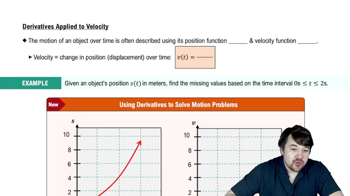
Velocity and Speed

Velocity is a vector quantity that refers to the rate of change of position with respect to time, including direction. Speed, on the other hand, is the magnitude of velocity and does not consider direction. In this context, understanding how velocity changes over time is crucial for determining when the speed of the stone is increasing.
Recommended video:
06:29
Derivatives Applied To Velocity

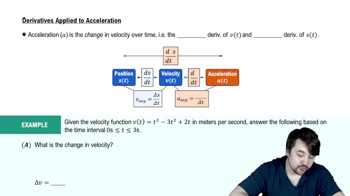
Acceleration

Acceleration is the rate of change of velocity with respect to time. In the given problem, the acceleration can be derived from the height function s(t) by taking the second derivative. A positive acceleration indicates that the speed is increasing, while a negative acceleration suggests that the speed is decreasing.
Recommended video:
06:15
Derivatives Applied To Acceleration

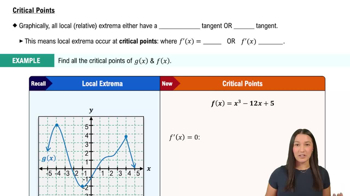
Critical Points and Intervals

Critical points occur where the first derivative of a function is zero or undefined, indicating potential maxima, minima, or points of inflection. To determine intervals where speed is increasing, one must analyze the sign of the derivative of the speed function (the absolute value of velocity) around these critical points, identifying where the speed transitions from decreasing to increasing.
Recommended video:
04:50
Critical Points
Related Practice
Textbook Question

Suppose a stone is thrown vertically upward from the edge of a cliff on Earth with an initial velocity of 19.6 m/s from a height of 24.5 m above the ground. The height (in meters) of the stone above the ground t seconds after it is thrown is s(t) = -4.9t2 + 19.6t + 24.5.

On what intervals is the speed increasing?

Textbook Question

Suppose a stone is thrown vertically upward from the edge of a cliff on Earth with an initial velocity of 32 ft/s from a height of 48 ft above the ground. The height (in feet) of the stone above the ground t seconds after it is thrown is s(t) = -16t2 + 32t + 48.

Determine the velocity v of the stone after t seconds.

Textbook Question

Once Kate’s kite reaches a height of 50 ft (above her hands), it rises no higher but drifts due east in a wind blowing 5 ft/s. How fast is the string running through Kate’s hands at the moment when she has released 120 ft of string?

Textbook Question

Suppose a stone is thrown vertically upward from the edge of a cliff on Earth with an initial velocity of 32 ft/s from a height of 48 ft above the ground. The height (in feet) of the stone above the ground t seconds after it is thrown is s(t) = -16t2 + 32t + 48.

With what velocity does the stone strike the ground?

Textbook Question

Throwing a stone Suppose a stone is thrown vertically upward from the edge of a cliff on Earth with an initial velocity of 32 ft/s from a height of 48 ft above the ground. The height (in feet) of the stone above the ground t seconds after it is thrown is s(t)=16t2+32t+48s(t)=-16t^2+32t+48 .

d. When does the stone strike the ground?

1
views
Textbook Question

Evaluate the derivative of the following functions.

f(x) = x2 + 2x3 cot-1 x - ln (1 + x2)