
Ch. 3 - Derivatives
Briggs - Calculus: Early Transcendentals 3rd Edition
Briggs3rd EditionCalculus: Early TranscendentalsISBN: 9780136847243Not the one you use?Change textbook
Chapter 3, Problem 3.6.24c

Suppose a stone is thrown vertically upward from the edge of a cliff on Earth with an initial velocity of 19.6 m/s from a height of 24.5 m above the ground. The height (in meters) of the stone above the ground t seconds after it is thrown is s(t) = -4.9t²+19.6t+24.5.
c. What is the height of the stone at the highest point?

Verified step by step guidance
1
To find the height of the stone at the highest point, we need to determine when the stone reaches its maximum height. This occurs when the velocity of the stone is zero.
The velocity of the stone is the derivative of the height function s(t) with respect to time t. So, we need to find the derivative s'(t).
Calculate the derivative: s'(t) = d/dt(-4.9t² + 19.6t + 24.5). Using the power rule, s'(t) = -9.8t + 19.6.
Set the derivative equal to zero to find the time t at which the stone reaches its maximum height: -9.8t + 19.6 = 0. Solve for t.
Once you have the value of t, substitute it back into the original height function s(t) = -4.9t² + 19.6t + 24.5 to find the height of the stone at the highest point.

Verified video answer for a similar problem:

This video solution was recommended by our tutors as helpful for the problem above.
Video duration:
4m
Was this helpful?

Key Concepts

Here are the essential concepts you must grasp in order to answer the question correctly.

Quadratic Functions

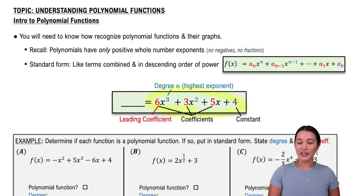
The height of the stone is modeled by a quadratic function, which is a polynomial of degree two. In this case, the function s(t) = -4.9t² + 19.6t + 24.5 represents a parabola that opens downward due to the negative coefficient of the t² term. Understanding the properties of quadratic functions, such as their vertex and axis of symmetry, is essential for determining the maximum height of the stone.
Recommended video:
6:04
Introduction to Polynomial Functions

Vertex of a Parabola

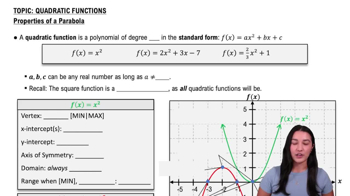
The highest point of a downward-opening parabola, like the one described by the height function, is called the vertex. The vertex can be found using the formula t = -b/(2a), where a and b are the coefficients from the quadratic equation. This point gives the time at which the stone reaches its maximum height, which is crucial for solving the problem.
Recommended video:
7:42
Properties of Parabolas

Maximum Value of a Function

To find the maximum height of the stone, we need to evaluate the height function at the time found from the vertex calculation. The maximum value of the function s(t) corresponds to the height of the stone at its peak. This involves substituting the time back into the original height equation to find the specific height at that moment.
Recommended video:
06:37
Average Value of a Function