
Ch. 3 - Derivatives
Briggs - Calculus: Early Transcendentals 3rd Edition
Briggs3rd EditionCalculus: Early TranscendentalsISBN: 9780136847243Not the one you use?Change textbook
Chapter 3, Problem 3.10.62c

62–65. {Use of Tech} Graphing f and f'
c. Verify that the zeros of f' correspond to points at which f has a horizontal tangent line.
f(x) = (x−1) sin^−1 x on [−1,1]

Verified step by step guidance
1
Step 1: Understand the problem. We need to verify that the zeros of the derivative of the function f(x) = (x-1) \(\sin\)^{-1}(x) correspond to points where the original function f(x) has a horizontal tangent line.
Step 2: Find the derivative f'(x). Use the product rule for differentiation, which states that if you have a function h(x) = u(x)v(x), then h'(x) = u'(x)v(x) + u(x)v'(x). Here, u(x) = (x-1) and v(x) = \(\sin\)^{-1}(x).
Step 3: Differentiate u(x) and v(x). The derivative of u(x) = (x-1) is u'(x) = 1. The derivative of v(x) = \(\sin\)^{-1}(x) is v'(x) = \(\frac{1}{\sqrt{1-x^2}\)}.
Step 4: Apply the product rule. Substitute u(x), u'(x), v(x), and v'(x) into the product rule formula to find f'(x). This gives f'(x) = 1 \(\cdot\) \(\sin\)^{-1}(x) + (x-1) \(\cdot\) \(\frac{1}{\sqrt{1-x^2}\)}.
Step 5: Find the zeros of f'(x). Set f'(x) = 0 and solve for x. These x-values are where the derivative is zero, indicating potential horizontal tangent lines on the graph of f(x). Verify these points by checking the graph of f(x) to see if the tangent is indeed horizontal at these x-values.

Verified video answer for a similar problem:

This video solution was recommended by our tutors as helpful for the problem above.
Video duration:
5m
Was this helpful?

Key Concepts

Here are the essential concepts you must grasp in order to answer the question correctly.

Derivative and Critical Points

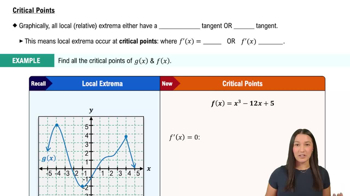
The derivative of a function, denoted as f', represents the rate of change of the function f. Critical points occur where the derivative is zero or undefined, indicating potential local maxima, minima, or points of inflection. In this context, finding the zeros of f' helps identify where the function f has horizontal tangent lines, which are essential for understanding the function's behavior.
Recommended video:
04:50
Critical Points

Horizontal Tangent Lines

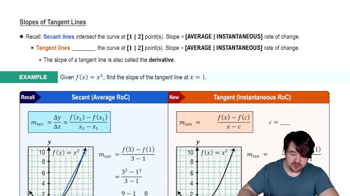
A horizontal tangent line occurs at points on the graph of a function where the slope is zero. This means that the derivative of the function at those points is equal to zero. In the given problem, verifying that the zeros of f' correspond to horizontal tangents involves checking that these points indicate where the function f does not increase or decrease, thus providing insights into its local behavior.
Recommended video:
05:13
Slopes of Tangent Lines

Graphing Functions

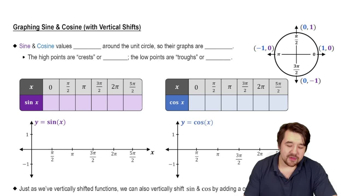
Graphing a function involves plotting its values on a coordinate system to visualize its behavior. For the function f(x) = (x−1) sin^−1 x, understanding its graph helps in identifying critical points and the nature of its tangents. By analyzing the graph of both f and its derivative f', one can visually confirm the relationship between the zeros of f' and the horizontal tangents of f.
Recommended video:
5:53
Graph of Sine and Cosine Function
Related Practice
Textbook Question

{Use of Tech} Spring runoff The flow of a small stream is monitored for 90 days between May 1 and August 1. The total water that flows past a gauging station is given by v(t) = <matrix 2x2> where V is measured in cubic feet and t is measured in days, with t=0 corresponding to May 1.

c. Describe the flow of the stream over the 3-month period. Specifically, when is the flow rate a maximum?

Textbook Question

Another way to approximate derivatives is to use the centered difference quotient: f' (a) ≈ f(a+h) - f(a- h) / 2h. Again, consider f(x) = √x.

c. Explain why it is not necessary to use negative values of h in the table of part (b).

Textbook Question

Suppose a stone is thrown vertically upward from the edge of a cliff on Earth with an initial velocity of 64 ft/s from a height of 32 ft above the ground. The height (in feet) of the stone above the ground t seconds after it is thrown is s(t) = -16t²+64t+32.

c. What is the height of the stone at the highest point?

Textbook Question

A rectangular swimming pool 10 ft wide by 20 ft long and of uniform depth is being filled with water.

c. At what rate is the water level rising if the pool is filled at a rate of 10ft³/min?

Textbook Question

Suppose a stone is thrown vertically upward from the edge of a cliff on Earth with an initial velocity of 19.6 m/s from a height of 24.5 m above the ground. The height (in meters) of the stone above the ground t seconds after it is thrown is s(t) = -4.9t²+19.6t+24.5.

c. What is the height of the stone at the highest point?

Textbook Question

Witch of Agnesi Let y(x²+4)=8 (see figure). <IMAGE>

c. Solve the equation y(x²+4)=8 for y to find an explicit expression for y and then calculate dy/dx.