
Ch. 3 - Derivatives
Briggs - Calculus: Early Transcendentals 3rd Edition
Briggs3rd EditionCalculus: Early TranscendentalsISBN: 9780136847243Not the one you use?Change textbook
Chapter 3, Problem 3.8.63c

Witch of Agnesi Let y(x²+4)=8 (see figure). <IMAGE>
c. Solve the equation y(x²+4)=8 for y to find an explicit expression for y and then calculate dy/dx.

Verified step by step guidance
1
Start by isolating y in the equation y(x² + 4) = 8. Divide both sides by (x² + 4) to get y = 8 / (x² + 4).
Now that you have y expressed explicitly as y = 8 / (x² + 4), the next step is to find the derivative dy/dx.
To find dy/dx, use the quotient rule for differentiation, which states that if you have a function in the form of u/v, then the derivative is (v * du/dx - u * dv/dx) / v².
In this case, let u = 8 and v = x² + 4. The derivative of u, du/dx, is 0 since 8 is a constant. The derivative of v, dv/dx, is 2x.
Apply the quotient rule: dy/dx = ((x² + 4) * 0 - 8 * 2x) / (x² + 4)². Simplify the expression to find the derivative dy/dx.

Verified video answer for a similar problem:

This video solution was recommended by our tutors as helpful for the problem above.
Video duration:
4m
Was this helpful?

Key Concepts

Here are the essential concepts you must grasp in order to answer the question correctly.

Implicit Function

An implicit function is a relation defined by an equation involving both dependent and independent variables, where the dependent variable is not isolated. In the context of the given equation y(x² + 4) = 8, y is expressed in terms of x, but not explicitly. Understanding how to manipulate such equations is crucial for solving for y.
Recommended video:
05:14
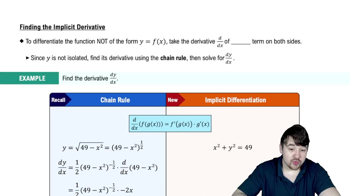
Finding The Implicit Derivative

Differentiation

Differentiation is the process of finding the derivative of a function, which represents the rate of change of the function with respect to its variable. In this case, calculating dy/dx involves applying the rules of differentiation to the implicit function derived from y(x² + 4) = 8. Mastery of differentiation techniques, such as the product rule, is essential for this step.
Recommended video:
05:53
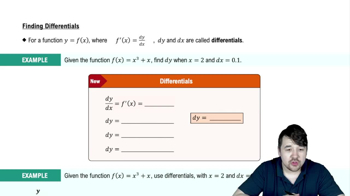
Finding Differentials

Witch of Agnesi

The Witch of Agnesi is a specific type of curve defined by the equation y = 8/(x² + 4), which is derived from the original equation by isolating y. This curve is notable in calculus for its properties and applications in various mathematical contexts. Understanding its shape and behavior helps in visualizing the results of differentiation and integration related to the curve.
Related Practice
Textbook Question

{Use of Tech} Spring runoff The flow of a small stream is monitored for 90 days between May 1 and August 1. The total water that flows past a gauging station is given by v(t) = <matrix 2x2> where V is measured in cubic feet and t is measured in days, with t=0 corresponding to May 1.

c. Describe the flow of the stream over the 3-month period. Specifically, when is the flow rate a maximum?

Textbook Question

Suppose a stone is thrown vertically upward from the edge of a cliff on Earth with an initial velocity of 64 ft/s from a height of 32 ft above the ground. The height (in feet) of the stone above the ground t seconds after it is thrown is s(t) = -16t²+64t+32.

c. What is the height of the stone at the highest point?

Textbook Question

Derivatives using tables Let h(x)=f(g(x))h(x)=f(g(x)) and p(x)=g(f(x))p(x)=g(f(x)). Use the table to compute the following derivatives.

<IMAGE>

c. p(4)p^{\(\prime\)}\(\left\)(4\(\right\))

Textbook Question

Throwing a stone Suppose a stone is thrown vertically upward from the edge of a cliff on Earth with an initial velocity of 32 ft/s from a height of 48 ft above the ground. The height (in feet) of the stone above the ground t seconds after it is thrown is s(t) = -16t²+32t+48.

c. What is the height of the stone at the highest point?

1
views
Textbook Question

A rectangular swimming pool 10 ft wide by 20 ft long and of uniform depth is being filled with water.

c. At what rate is the water level rising if the pool is filled at a rate of 10ft³/min?

Textbook Question

62–65. {Use of Tech} Graphing f and f'

c. Verify that the zeros of f' correspond to points at which f has a horizontal tangent line.

f(x) = (x−1) sin^−1 x on [−1,1]