
Ch. 3 - Derivatives
Briggs - Calculus: Early Transcendentals 3rd Edition
Briggs3rd EditionCalculus: Early TranscendentalsISBN: 9780136847243Not the one you use?Change textbook
Chapter 3, Problem 3.10.64c

62–65. {Use of Tech} Graphing f and f'
c. Verify that the zeros of f' correspond to points at which f has a horizontal tangent line.
f(x)=(sec^−1 x)/x on [1,∞)

Verified step by step guidance
1
Step 1: Understand the function f(x) = \(\frac{\sec^{-1}\)(x)}{x} and its domain [1, \(\infty\)). The function involves the inverse secant function, which is defined for x \(\geq\) 1.
Step 2: Find the derivative f'(x) using the quotient rule. The quotient rule states that if you have a function h(x) = \(\frac{u(x)}{v(x)}\), then h'(x) = \(\frac{u'(x)v(x) - u(x)v'(x)}{(v(x))^2}\). Here, u(x) = \(\sec\)^{-1}(x) and v(x) = x.
Step 3: Calculate the derivatives u'(x) and v'(x). For u(x) = \(\sec\)^{-1}(x), use the derivative formula \(\frac{d}{dx}\)[\(\sec\)^{-1}(x)] = \(\frac{1}{|x|\sqrt{x^2 - 1}\)}. For v(x) = x, the derivative v'(x) = 1.
Step 4: Substitute u'(x), u(x), v'(x), and v(x) into the quotient rule formula to find f'(x). Simplify the expression to get the derivative in a manageable form.
Step 5: Set f'(x) = 0 to find the zeros of the derivative. These zeros correspond to the x-values where the original function f(x) has horizontal tangent lines. Verify these points by checking the graph of f(x) and f'(x) using technology.

Verified video answer for a similar problem:

This video solution was recommended by our tutors as helpful for the problem above.
Video duration:
8m
Was this helpful?

Key Concepts

Here are the essential concepts you must grasp in order to answer the question correctly.

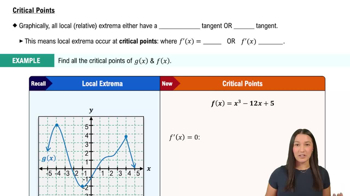
Derivative and Critical Points

The derivative of a function, denoted as f'(x), represents the rate of change of the function f(x) at any point x. Critical points occur where the derivative is zero or undefined, indicating potential locations for horizontal tangent lines. Understanding how to find and interpret these points is essential for analyzing the behavior of the function.
Recommended video:
04:50
Critical Points

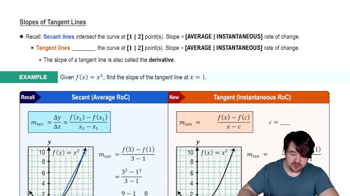
Horizontal Tangent Lines

A horizontal tangent line occurs at points where the derivative of a function equals zero, meaning the slope of the tangent line is flat. This indicates that the function is neither increasing nor decreasing at that point, which is crucial for identifying local maxima, minima, or points of inflection. Verifying these points involves checking where f'(x) = 0.
Recommended video:
05:13
Slopes of Tangent Lines

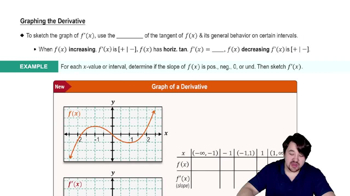
Graphing Functions and Their Derivatives

Graphing a function f(x) alongside its derivative f'(x) provides visual insight into the function's behavior. The zeros of f' correspond to the x-values where f has horizontal tangents, allowing for a clear understanding of how the function behaves at those points. This graphical representation aids in confirming the relationship between a function and its derivative.
Recommended video:
06:15
Graphing The Derivative
Related Practice
Textbook Question

{Use of Tech} Power and energy Power and energy are often used interchangeably, but they are quite different. Energy is what makes matter move or heat up. It is measured in units of joules or Calories, where 1 Cal=4184 J. One hour of walking consumes roughly 10⁶J, or 240 Cal. On the other hand, power is the rate at which energy is used, which is measured in watts, where 1 W=1 J/s. Other useful units of power are kilowatts (1 kW=10³ W) and megawatts (1 MW=10⁶ W). If energy is used at a rate of 1 kW for one hour, the total amount of energy used is 1 kilowatt-hour (1 kWh=3.6×10⁶ J) Suppose the cumulative energy used in a large building over a 24-hr period is given by E(t)=100t+4t²−t³ / 9kWh where t=0 corresponds to midnight.

c. Graph the power function and interpret the graph. What are the units of power in this case?

Textbook Question

Another way to approximate derivatives is to use the centered difference quotient: f' (a) ≈ f(a+h) - f(a- h) / 2h. Again, consider f(x) = √x.

c. Explain why it is not necessary to use negative values of h in the table of part (b).

Textbook Question

Derivatives from a graph If possible, evaluate the following derivatives using the graphs of f and f'. <IMAGE>

c. (f^-1)'(f(2))

1
views
Textbook Question

Derivatives of sin^n x Calculate the following derivatives using the Product Rule.

c. d/dx (sin⁴ x)

Textbook Question

Vertical tangent lines If a function f is continuous at a and lim x→a| f′(x)|=∞, then the curve y=f(x) has a vertical tangent line at a, and the equation of the tangent line is x=a. If a is an endpoint of a domain, then the appropriate one-sided derivative (Exercises 71–72) is used. Use this information to answer the following questions.

73. {Use of Tech} Graph the following functions and determine the location of the vertical tangent lines.

c. f(x) = √|x-4|

Textbook Question

Suppose a stone is thrown vertically upward from the edge of a cliff on Earth with an initial velocity of 19.6 m/s from a height of 24.5 m above the ground. The height (in meters) of the stone above the ground t seconds after it is thrown is s(t) = -4.9t²+19.6t+24.5.

c. What is the height of the stone at the highest point?