
Ch. 3 - Derivatives
Briggs - Calculus: Early Transcendentals 3rd Edition
Briggs3rd EditionCalculus: Early TranscendentalsISBN: 9780136847243Not the one you use?Change textbook
Chapter 3, Problem 3.5.87.c

Derivatives of sin^n x Calculate the following derivatives using the Product Rule.
c. d/dx (sin⁴ x)

Verified step by step guidance
1
First, recognize that the function sin⁴(x) can be rewritten as (sin(x))⁴. This helps in applying the chain rule effectively.
Apply the chain rule: If you have a function u(x) raised to a power n, the derivative is n * u(x)^(n-1) * u'(x). Here, u(x) = sin(x) and n = 4.
Calculate the derivative of u(x) = sin(x), which is u'(x) = cos(x).
Substitute u(x) = sin(x) and u'(x) = cos(x) into the chain rule formula: 4 * (sin(x))³ * cos(x).
Simplify the expression to get the derivative: 4 * sin³(x) * cos(x). This is the derivative of sin⁴(x) using the chain rule.

Verified video answer for a similar problem:

This video solution was recommended by our tutors as helpful for the problem above.
Video duration:
4m
Was this helpful?

Key Concepts

Here are the essential concepts you must grasp in order to answer the question correctly.

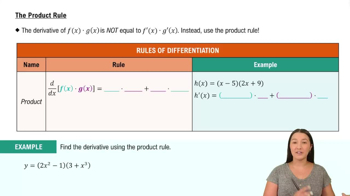
Product Rule

The Product Rule is a fundamental differentiation technique used when finding the derivative of a product of two functions. It states that if you have two functions, u(x) and v(x), the derivative of their product is given by d/dx [u(x)v(x)] = u'(x)v(x) + u(x)v'(x). This rule is essential for calculating derivatives where functions are multiplied together, such as in the case of sin^n x.
Recommended video:
05:18
The Product Rule

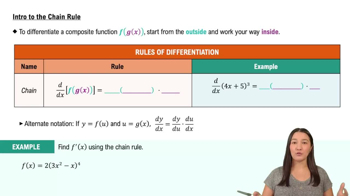
Chain Rule

The Chain Rule is another critical differentiation rule used when dealing with composite functions. It states that if a function y is composed of another function u, such that y = f(u) and u = g(x), then the derivative is given by dy/dx = dy/du * du/dx. In the context of sin^n x, the Chain Rule is necessary to differentiate the inner function (sin x) raised to a power.
Recommended video:
05:02
Intro to the Chain Rule

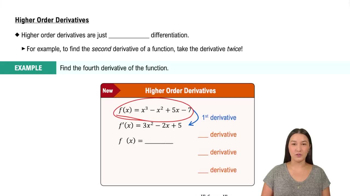
Higher Order Derivatives

Higher order derivatives refer to the derivatives of a function taken multiple times. For example, the second derivative is the derivative of the first derivative. In the context of sin^n x, understanding higher order derivatives can be important for analyzing the behavior of the function, such as concavity and points of inflection, especially when applying the Product Rule and Chain Rule in more complex scenarios.
Recommended video:
02:42
Higher Order Derivatives
Related Practice
Textbook Question

{Use of Tech} Power and energy Power and energy are often used interchangeably, but they are quite different. Energy is what makes matter move or heat up. It is measured in units of joules or Calories, where 1 Cal=4184 J. One hour of walking consumes roughly 10⁶J, or 240 Cal. On the other hand, power is the rate at which energy is used, which is measured in watts, where 1 W=1 J/s. Other useful units of power are kilowatts (1 kW=10³ W) and megawatts (1 MW=10⁶ W). If energy is used at a rate of 1 kW for one hour, the total amount of energy used is 1 kilowatt-hour (1 kWh=3.6×10⁶ J) Suppose the cumulative energy used in a large building over a 24-hr period is given by E(t)=100t+4t²−t³ / 9kWh where t=0 corresponds to midnight.

c. Graph the power function and interpret the graph. What are the units of power in this case?

Textbook Question

Derivatives of inverse functions from a table Use the following tables to determine the indicated derivatives or state that the derivative cannot be determined. <IMAGE>

c. (f^-1)'(1)

Textbook Question

62–65. {Use of Tech} Graphing f and f'

c. Verify that the zeros of f' correspond to points at which f has a horizontal tangent line.

f(x)=(sec^−1 x)/x on [1,∞)

Textbook Question

{Use of Tech} Spring oscillations A spring hangs from the ceiling at equilibrium with a mass attached to its end. Suppose you pull downward on the mass and release it 10 inches below its equilibrium position with an upward push. The distance x (in inches) of the mass from its equilibrium position after t seconds is given by the function x(t) = 10sin t−10cos t, where x is positive when the mass is above the equilibrium position. <IMAGE>

c. At what times is the velocity of the mass zero?

Textbook Question

Derivatives from a graph If possible, evaluate the following derivatives using the graphs of f and f'. <IMAGE>

c. (f^-1)'(f(2))

1
views
Textbook Question

Vertical tangent lines If a function f is continuous at a and lim x→a| f′(x)|=∞, then the curve y=f(x) has a vertical tangent line at a, and the equation of the tangent line is x=a. If a is an endpoint of a domain, then the appropriate one-sided derivative (Exercises 71–72) is used. Use this information to answer the following questions.

73. {Use of Tech} Graph the following functions and determine the location of the vertical tangent lines.

c. f(x) = √|x-4|