
Ch. 3 - Derivatives
Briggs - Calculus: Early Transcendentals 3rd Edition
Briggs3rd EditionCalculus: Early TranscendentalsISBN: 9780136847243Not the one you use?Change textbook
Chapter 3, Problem 3.5.65.b

Explain why or why not Determine whether the following statements are true and give an explanation or counter example.
b. d²/dx² (sin x) = sin x.

Verified step by step guidance
1
To determine if the statement \( \frac{d^2}{dx^2} (\sin x) = \sin x \) is true, we need to find the second derivative of \( \sin x \).
First, find the first derivative of \( \sin x \). The derivative of \( \sin x \) with respect to \( x \) is \( \cos x \).
Next, find the second derivative by differentiating \( \cos x \). The derivative of \( \cos x \) with respect to \( x \) is \( -\sin x \).
Thus, the second derivative of \( \sin x \) is \( -\sin x \), not \( \sin x \).
Therefore, the statement \( \frac{d^2}{dx^2} (\sin x) = \sin x \) is false. The correct second derivative is \( -\sin x \).

Verified video answer for a similar problem:

This video solution was recommended by our tutors as helpful for the problem above.
Video duration:
1m
Was this helpful?

Key Concepts

Here are the essential concepts you must grasp in order to answer the question correctly.

Second Derivative

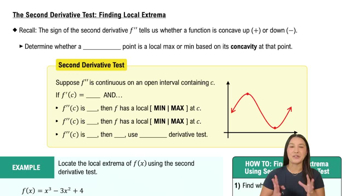
The second derivative of a function measures the rate of change of the first derivative. It provides information about the concavity of the function and can indicate points of inflection. In this context, calculating the second derivative of sin x involves differentiating the function twice with respect to x.
Recommended video:
06:02
The Second Derivative Test: Finding Local Extrema

Trigonometric Functions

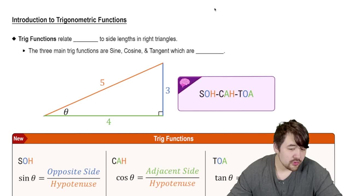
Trigonometric functions, such as sine and cosine, are periodic functions that relate angles to ratios of sides in right triangles. The sine function, sin x, oscillates between -1 and 1 and has a specific pattern of derivatives: the first derivative is cos x, and the second derivative is -sin x.
Recommended video:
6:04
Introduction to Trigonometric Functions

True/False Statements in Calculus

In calculus, determining the truth of a statement often involves verifying mathematical identities or properties. For the statement d²/dx² (sin x) = sin x, one must compute the second derivative and compare it to sin x to establish its validity, which in this case reveals that the statement is false.
Recommended video:
05:22
Fundamental Theorem of Calculus Part 2
Related Practice
Textbook Question

97–100. Logistic growth Scientists often use the logistic growth function P(t) = P₀K / P₀+(K−P₀)e^−r₀t to model population growth, where P₀ is the initial population at time t=0, K is the carrying capacity, and r₀ is the base growth rate. The carrying capacity is a theoretical upper bound on the total population that the surrounding environment can support. The figure shows the sigmoid (S-shaped) curve associated with a typical logistic model. <IMAGE>


{Use of Tech} Gone fishing When a reservoir is created by a new dam, 50 fish are introduced into the reservoir, which has an estimated carrying capacity of 8000 fish. A logistic model of the fish population is P(t) = 400,000 / 50+7950e^−0.5t, where t is measured in years.


b. How long does it take for the population to reach 5000 fish? How long does it take for the population to reach 90% of the carrying capacity?

Textbook Question

Derivatives of inverse functions from a table Use the following tables to determine the indicated derivatives or state that the derivative cannot be determined. <IMAGE>

b. (f^-1)'(6)

Textbook Question

A race Jean and Juan run a one-lap race on a circular track. Their angular positions on the track during the race are given by the functions θ(t) and ϕ(t), respectively, where 0≤t≤4 and t is measured in minutes (see figure). These angles are measured in radians, where θ=ϕ=0 represent the starting position and θ=ϕ=2π represent the finish position. The angular velocities of the runners are θ′(t) and ϕ′(t). <IMAGE>

b. Which runner has the greater average angular velocity?

1
views
Textbook Question

Derivatives using tables Let h(x)=f(g(x))h(x)=f(g(x)) and p(x)=g(f(x))p(x)=g(f(x)). Use the table to compute the following derivatives.

<IMAGE>

b. h(2)h^{\(\prime\)}\(\left\)(2\(\right\))

Textbook Question

{Use of Tech} Fuel economy Suppose you own a fuel-efficient hybrid automobile with a monitor on the dashboard that displays the mileage and gas consumption. The number of miles you can drive with g gallons of gas remaining in the tank on a particular stretch of highway is given by m(g) = 50g−25.8g²+12.5g³−1.6g⁴, for 0≤g≤4.

b. Graph and interpret the gas mileage m(g)/g. 

Textbook Question

79–82. {Use of Tech} Visualizing tangent and normal lines

b. Graph the tangent and normal lines on the given graph.

(x²+y²)² = 25/3 (x²-y²); (x0,y0) = (2,-1) (lemniscate of Bernoulli)

1
views