
Ch. 3 - Derivatives
Briggs - Calculus: Early Transcendentals 3rd Edition
Briggs3rd EditionCalculus: Early TranscendentalsISBN: 9780136847243Not the one you use?Change textbook
Chapter 3, Problem 3.7.25b

Derivatives using tables Let h(x)=f(g(x))h(x)=f(g(x)) and p(x)=g(f(x))p(x)=g(f(x)). Use the table to compute the following derivatives.
<IMAGE>
b. h(2)h^{\(\prime\)}\(\left\)(2\(\right\))

Verified step by step guidance
1
Identify that h(x) = f(g(x)) is a composition of functions, which requires the use of the chain rule to find its derivative.
Recall the chain rule: if h(x) = f(g(x)), then h'(x) = f'(g(x)) * g'(x).
To find h'(2), substitute x = 2 into the derivative expression: h'(2) = f'(g(2)) * g'(2).
Use the table to find the values of g(2) and g'(2). Substitute these values into the expression.
Next, use the table to find f'(g(2)) by first finding g(2) and then using this result to find f' at that point. Substitute this value into the expression to complete the calculation of h'(2).

Verified video answer for a similar problem:

This video solution was recommended by our tutors as helpful for the problem above.
Video duration:
2m
Was this helpful?

Key Concepts

Here are the essential concepts you must grasp in order to answer the question correctly.

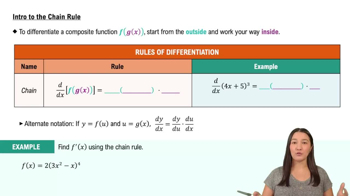
Chain Rule

The Chain Rule is a fundamental theorem in calculus used to differentiate composite functions. It states that if a function h(x) is composed of two functions, f(g(x)), the derivative h'(x) can be found by multiplying the derivative of the outer function f with the derivative of the inner function g. Mathematically, this is expressed as h'(x) = f'(g(x)) * g'(x). Understanding this rule is essential for solving problems involving derivatives of composite functions.
Recommended video:
05:02
Intro to the Chain Rule

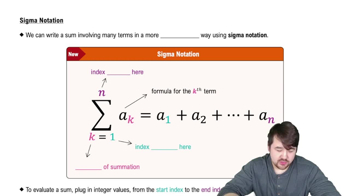
Derivative Notation

Derivative notation, such as h'(x) or f'(x), represents the rate of change of a function with respect to its variable. It indicates how the function's output changes as its input changes. In the context of the question, h'(2) specifically refers to the derivative of the function h evaluated at x = 2. Familiarity with this notation is crucial for interpreting and calculating derivatives correctly.
Recommended video:
04:22
Sigma Notation

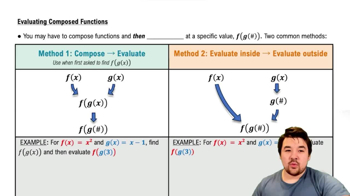
Function Evaluation

Function evaluation involves substituting a specific value into a function to determine its output. In the context of derivatives, evaluating functions at certain points, such as h(2) or g(f(2)), is necessary to compute the derivative using the Chain Rule. This concept is vital for applying the derivatives obtained from the Chain Rule to find specific values, which is often required in calculus problems.
Recommended video:
4:26
Evaluating Composed Functions
Related Practice
Textbook Question

A race Jean and Juan run a one-lap race on a circular track. Their angular positions on the track during the race are given by the functions θ(t) and ϕ(t), respectively, where 0≤t≤4 and t is measured in minutes (see figure). These angles are measured in radians, where θ=ϕ=0 represent the starting position and θ=ϕ=2π represent the finish position. The angular velocities of the runners are θ′(t) and ϕ′(t). <IMAGE>

b. Which runner has the greater average angular velocity?

1
views
Textbook Question

Derivatives and tangent lines

b. Determine an equation of the line tangent to the graph of f at the point (a,f(a)) for the given value of a.

f(x) = √3x; a= 12

1
views
Textbook Question

Explain why or why not Determine whether the following statements are true and give an explanation or counter example.

b. d²/dx² (sin x) = sin x.

Textbook Question

{Use of Tech} Spring oscillations A spring hangs from the ceiling at equilibrium with a mass attached to its end. Suppose you pull downward on the mass and release it 10 inches below its equilibrium position with an upward push. The distance x (in inches) of the mass from its equilibrium position after t seconds is given by the function x(t) = 10sin t - 10cos t, where x is positive when the mass is above the equilibrium position. <IMAGE>

b. Find dx/dt and interpret the meaning of this derivative.  

1
views
Textbook Question

21–30. Derivatives

b. Evaluate f'(a) for the given values of a.

f(x) = 1/x+1; a = -1/2;5

Textbook Question

79–82. {Use of Tech} Visualizing tangent and normal lines

b. Graph the tangent and normal lines on the given graph.

(x²+y²)² = 25/3 (x²-y²); (x0,y0) = (2,-1) (lemniscate of Bernoulli)

1
views