
Ch. 3 - Derivatives
Briggs - Calculus: Early Transcendentals 3rd Edition
Briggs3rd EditionCalculus: Early TranscendentalsISBN: 9780136847243Not the one you use?Change textbook
Chapter 3, Problem 3.10.7b

Derivatives of inverse functions from a table Use the following tables to determine the indicated derivatives or state that the derivative cannot be determined. <IMAGE>
b. (f^-1)'(6)

Verified step by step guidance
1
Identify the relationship between the function \( f \) and its inverse \( f^{-1} \). Recall that if \( y = f(x) \), then \( x = f^{-1}(y) \).
Use the formula for the derivative of an inverse function: \((f^{-1})'(b) = \frac{1}{f'(a)}\), where \( f(a) = b \).
From the problem, we need to find \((f^{-1})'(6)\). This means we need to find \( a \) such that \( f(a) = 6 \).
Look at the table provided to find the value of \( a \) for which \( f(a) = 6 \).
Once \( a \) is identified, find \( f'(a) \) from the table and use the formula \((f^{-1})'(6) = \frac{1}{f'(a)}\) to determine the derivative.

Verified video answer for a similar problem:

This video solution was recommended by our tutors as helpful for the problem above.
Video duration:
3m
Was this helpful?

Key Concepts

Here are the essential concepts you must grasp in order to answer the question correctly.

Inverse Functions

An inverse function reverses the effect of the original function. If f(x) takes an input x and produces an output y, then the inverse function f^-1(y) takes y back to x. Understanding how to find and interpret inverse functions is crucial for solving problems involving derivatives of these functions.
Recommended video:
4:49
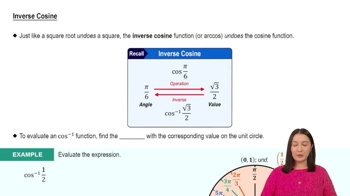
Inverse Cosine

Derivative of Inverse Functions

The derivative of an inverse function can be calculated using the formula (f^-1)'(y) = 1 / f'(x), where y = f(x). This relationship shows that the rate of change of the inverse function at a point is the reciprocal of the rate of change of the original function at the corresponding point. This concept is essential for determining the derivative of f^-1 at a specific value.
Recommended video:
07:26
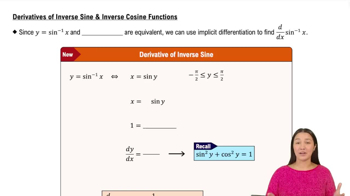
Derivatives of Inverse Sine & Inverse Cosine

Using Tables for Derivatives

In calculus, tables can provide values of functions and their derivatives at specific points. When asked to find the derivative of an inverse function using a table, one must locate the corresponding values for f and f' to apply the inverse derivative formula. This method is particularly useful when explicit functions are not available.
Recommended video:
05:44
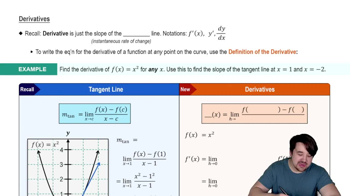
Derivatives
Related Practice
Textbook Question

97–100. Logistic growth Scientists often use the logistic growth function P(t) = P₀K / P₀+(K−P₀)e^−r₀t to model population growth, where P₀ is the initial population at time t=0, K is the carrying capacity, and r₀ is the base growth rate. The carrying capacity is a theoretical upper bound on the total population that the surrounding environment can support. The figure shows the sigmoid (S-shaped) curve associated with a typical logistic model. <IMAGE>


{Use of Tech} Gone fishing When a reservoir is created by a new dam, 50 fish are introduced into the reservoir, which has an estimated carrying capacity of 8000 fish. A logistic model of the fish population is P(t) = 400,000 / 50+7950e^−0.5t, where t is measured in years.


b. How long does it take for the population to reach 5000 fish? How long does it take for the population to reach 90% of the carrying capacity?

Textbook Question

Consider the following cost functions.

b. Determine the average cost and the marginal cost when x=a.

C(x) = − 0.01x²+40x+100, 0≤x≤1500, a=1000

Textbook Question

Explain why or why not Determine whether the following statements are true and give an explanation or counter example.

b. d²/dx² (sin x) = sin x.

Textbook Question

{Use of Tech} Fuel economy Suppose you own a fuel-efficient hybrid automobile with a monitor on the dashboard that displays the mileage and gas consumption. The number of miles you can drive with g gallons of gas remaining in the tank on a particular stretch of highway is given by m(g) = 50g−25.8g²+12.5g³−1.6g⁴, for 0≤g≤4.

b. Graph and interpret the gas mileage m(g)/g. 

Textbook Question

79–82. {Use of Tech} Visualizing tangent and normal lines

b. Graph the tangent and normal lines on the given graph.

(x²+y²)² = 25/3 (x²-y²); (x0,y0) = (2,-1) (lemniscate of Bernoulli)

1
views
Textbook Question

45–50. Tangent lines Carry out the following steps. <IMAGE>

b. Determine an equation of the line tangent to the curve at the given point.

x⁴-x²y+y⁴=1; (−1, 1)

1
views