Ch. 3 - Derivatives
Briggs - Calculus: Early Transcendentals 3rd Edition
Briggs3rd EditionCalculus: Early TranscendentalsISBN: 9780136847243Not the one you use?Change textbook
Chapter 3, Problem 3.6.59a

A woman attached to a bungee cord jumps from a bridge that is 30 m above a river. Her height in meters above the river t seconds after the jump is y(t) = 15(1+e-t cos t), for t ≥ 0.
Determine her velocity at t = 1 and t = 3. 

Verified step by step guidance
1
To find the velocity of the woman at a given time, we need to determine the derivative of her height function y(t) with respect to time t. The derivative, y'(t), represents the velocity.
The height function is given as y(t) = 15(1 + e^(-t) * cos(t)). We will apply the product rule and chain rule to differentiate this function.
First, identify the components of the function: u(t) = e^(-t) and v(t) = cos(t). The product rule states that the derivative of u(t) * v(t) is u'(t) * v(t) + u(t) * v'(t).
Calculate the derivatives: u'(t) = -e^(-t) (using the chain rule for e^(-t)) and v'(t) = -sin(t) (derivative of cos(t)).
Substitute these derivatives into the product rule formula: y'(t) = 15 * [(-e^(-t) * cos(t)) + (e^(-t) * (-sin(t)))]. Evaluate y'(t) at t = 1 and t = 3 to find the velocity at these times.

Verified video answer for a similar problem:

This video solution was recommended by our tutors as helpful for the problem above.
Video duration:
5m
Was this helpful?

Key Concepts

Here are the essential concepts you must grasp in order to answer the question correctly.

Differentiation

Differentiation is a fundamental concept in calculus that involves finding the derivative of a function. The derivative represents the rate of change of the function with respect to its variable, which in this case is time. To determine the velocity of the woman at specific times, we need to differentiate her height function y(t) with respect to t, yielding the velocity function v(t).
Recommended video:
05:53
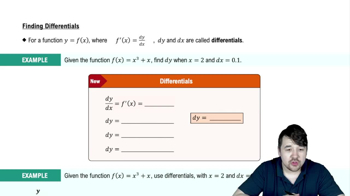
Finding Differentials

Exponential Functions

Exponential functions are mathematical functions of the form f(t) = a * e^(bt), where e is Euler's number. In the given height function y(t), the term e^(-t) indicates that the height changes exponentially over time. Understanding how exponential decay affects the height is crucial for accurately calculating the velocity at different time points.
Recommended video:
6:13
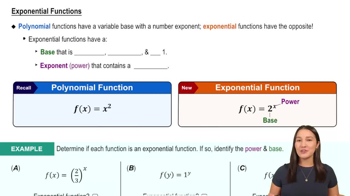
Exponential Functions

Trigonometric Functions

Trigonometric functions, such as sine and cosine, are periodic functions that relate angles to ratios of sides in right triangles. In the height function y(t), the cosine term introduces oscillatory behavior to the height over time. Recognizing how the cosine function influences the overall height is important for evaluating the velocity at specific moments during the jump.
Recommended video:
6:04
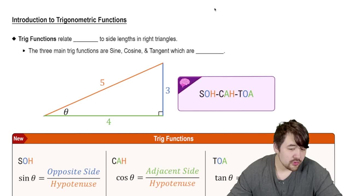
Introduction to Trigonometric Functions
Related Practice
Textbook Question

Volume of a torus The volume of a torus (doughnut or bagel) with an inner radius of a and an outer radius of b is V=π²(b+a)(b−a)²/4.

a. Find db/da for a torus with a volume of 64π².

Textbook Question

79–82. {Use of Tech} Visualizing tangent and normal lines <IMAGE>

a. Determine an equation of the tangent line and the normal line at the given point (x0, y0) on the following curves. (See instructions for Exercises 73–78.)

x⁴ = 2x²+2y²; (x0, y0)=(2, 2) (kampyle of Eudoxus)

Textbook Question

Comparing velocities Two stones are thrown vertically upward, each with an initial velocity of 48 ft/s at time t=0. One stone is thrown from the edge of a bridge that is 32 feet above the ground, and the other stone is thrown from ground level. The height above the ground of the stone thrown from the bridge after t seconds is f(t) = − 16t²+48t+32. and the height of the stone thrown from the ground after t seconds is g(t) = −16t²+48t.

a. Show that the stones reach their high points at the same time.

Textbook Question

31–32. Velocity functions A projectile is fired vertically upward into the air, and its position (in feet) above the ground after t seconds is given by the function s(t).

a. For the following functions s(t), find the instantaneous velocity function v(t). (Recall that the velocity function v is the derivative of the position function s.)

s(t)= −16t²+100t

Textbook Question

Use definition (1) (p. 133) to find the slope of the line tangent to the graph of f at P.

f(x) = 2/√x; P(4,1)

Textbook Question

Use definition (2) (p. 135) to find the slope of the line tangent to the graph of f at P.

f(x) = 2x + 1; P(0,1)