
Textbook Question
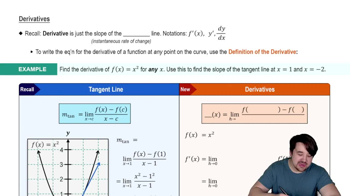
Use definition (2) (p. 135) to find the slope of the line tangent to the graph of f at P.
f(x) = 3x2 - 4x; P(1, -1)

 Verified step by step guidance
 05:44
05:44
 06:29
06:29 6:04
6:04Use definition (2) (p. 135) to find the slope of the line tangent to the graph of f at P.
f(x) = 3x2 - 4x; P(1, -1)
21–30. Derivatives
a. Use limits to find the derivative function f' for the following functions f.
f(s) = 4s³+3s; a= -3, -1
79–82. {Use of Tech} Visualizing tangent and normal lines <IMAGE>
a. Determine an equation of the tangent line and the normal line at the given point (x0, y0) on the following curves. (See instructions for Exercises 73–78.)
x⁴ = 2x²+2y²; (x0, y0)=(2, 2) (kampyle of Eudoxus)
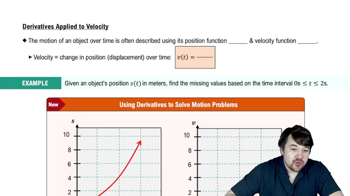
A woman attached to a bungee cord jumps from a bridge that is 30 m above a river. Her height in meters above the river t seconds after the jump is y(t) = 15(1+e-t cos t), for t ≥ 0.
Determine her velocity at t = 1 and t = 3.
Comparing velocities Two stones are thrown vertically upward, each with an initial velocity of 48 ft/s at time t=0. One stone is thrown from the edge of a bridge that is 32 feet above the ground, and the other stone is thrown from ground level. The height above the ground of the stone thrown from the bridge after t seconds is f(t) = − 16t²+48t+32. and the height of the stone thrown from the ground after t seconds is g(t) = −16t²+48t.
a. Show that the stones reach their high points at the same time.
Consider the following cost functions.
a. Find the average cost and marginal cost functions.
C(x) = 1000+0.1x, 0≤x≤5000, a=2000