
Ch. 3 - Derivatives
Briggs - Calculus: Early Transcendentals 3rd Edition
Briggs3rd EditionCalculus: Early TranscendentalsISBN: 9780136847243Not the one you use?Change textbook
Chapter 3, Problem 3.8.44a

Volume of a torus The volume of a torus (doughnut or bagel) with an inner radius of a and an outer radius of b is V=π²(b+a)(b−a)²/4.
a. Find db/da for a torus with a volume of 64π².

Verified step by step guidance
1
Start by understanding the given formula for the volume of a torus: V = π²(b+a)(b−a)²/4. We need to find the derivative db/da when the volume V is 64π².
Set the volume equation equal to 64π²: π²(b+a)(b−a)²/4 = 64π². Simplify this equation to find a relationship between a and b.
Multiply both sides of the equation by 4/π² to isolate the terms involving a and b: (b+a)(b−a)² = 256.
To find db/da, implicitly differentiate both sides of the equation with respect to a. Use the product rule and chain rule where necessary.
Solve the resulting equation for db/da, ensuring to substitute any known values or relationships between a and b from the previous steps.

Verified video answer for a similar problem:

This video solution was recommended by our tutors as helpful for the problem above.
Video duration:
7m
Was this helpful?

Key Concepts

Here are the essential concepts you must grasp in order to answer the question correctly.

Volume of a Torus

The volume of a torus is calculated using the formula V = π²(b + a)(b - a)²/4, where 'a' is the inner radius and 'b' is the outer radius. This formula derives from integrating the area of circular cross-sections of the torus. Understanding this formula is crucial for solving problems related to the volume and dimensions of a torus.
Recommended video:
08:29
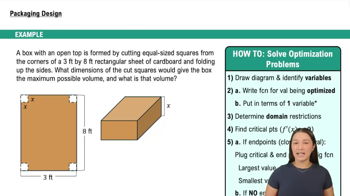
Example 5: Packaging Design

Differentiation

Differentiation is a fundamental concept in calculus that involves finding the rate at which a function changes at any given point. In this context, we need to differentiate the volume formula with respect to 'a' to find db/da, which represents how the outer radius 'b' changes as the inner radius 'a' changes while keeping the volume constant.
Recommended video:
05:53
Finding Differentials

Implicit Differentiation

Implicit differentiation is a technique used when dealing with equations where one variable is not explicitly solved for another. In this case, since the volume is constant (64π²), we can use implicit differentiation on the volume formula to relate the changes in 'a' and 'b'. This method allows us to find the derivative db/da without isolating 'b' in the equation.
Recommended video:
05:14
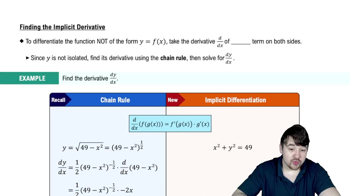
Finding The Implicit Derivative