
Textbook Question
Derivatives and tangent lines
a. For the following functions and values of a, find f′(a).
f(x) = √2x+1; a= 4

 Verified step by step guidance
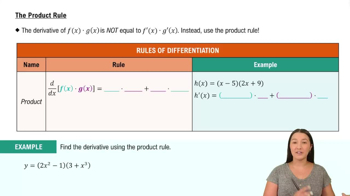
 05:18
05:18
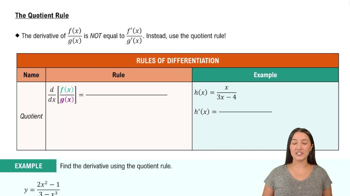 06:43
06:43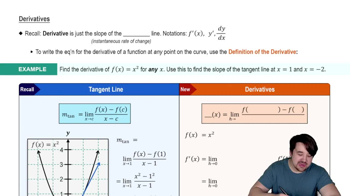 05:44
05:44Derivatives and tangent lines
a. For the following functions and values of a, find f′(a).
f(x) = √2x+1; a= 4
Tracking a dive A biologist standing at the bottom of an 80-foot vertical cliff watches a peregrine falcon dive from the top of the cliff at a 45° angle from the horizontal (see figure). <IMAGE>
a. Express the angle of elevation θ from the biologist to the falcon as a function of the height h of the bird above the ground. (Hint: The vertical distance between the top of the cliff and the falcon is 80−h.)
21–30. Derivatives
a. Use limits to find the derivative function f' for the following functions f.
f(x) = 4x²+1; a= 2,4
62–65. {Use of Tech} Graphing f and f'
a. Graph f with a graphing utility.
f(x)=e^−x tan^−1 x on [0,∞)
Derivatives of inverse functions from a table Use the following tables to determine the indicated derivatives or state that the derivative cannot be determined. <IMAGE>
a. (f^-1)'(4)
City urbanization City planners model the size of their city using the function A(t) = - 1/50t² + 2t +20, for 0 ≤ t ≤ 50, where A is measured in square miles and t is the number of years after 2010.
a. Compute A'(t). What units are associated with this derivative and what does the derivative measure?