Ch. 3 - Derivatives
Briggs - Calculus: Early Transcendentals 3rd Edition
Briggs3rd EditionCalculus: Early TranscendentalsISBN: 9780136847243Not the one you use?Change textbook
Chapter 3, Problem 3.10.7a

Derivatives of inverse functions from a table Use the following tables to determine the indicated derivatives or state that the derivative cannot be determined. <IMAGE>
a. (f^-1)'(4)

Verified step by step guidance
1
Step 1: Understand the problem. We need to find the derivative of the inverse function \((f^{-1})'(4)\). This involves using the formula for the derivative of an inverse function.
Step 2: Recall the formula for the derivative of an inverse function. If \(y = f^{-1}(x)\), then \((f^{-1})'(x) = \frac{1}{f'(y)}\) where \(y = f^{-1}(x)\).
Step 3: Identify the value of \(y\) such that \(f(y) = 4\). This means we need to find \(y\) from the table where \(f(y) = 4\).
Step 4: Once \(y\) is identified, find \(f'(y)\) from the table. This is the derivative of \(f\) at the point \(y\).
Step 5: Use the formula \((f^{-1})'(4) = \frac{1}{f'(y)}\) to find the derivative of the inverse function at \(x = 4\).

Verified video answer for a similar problem:

This video solution was recommended by our tutors as helpful for the problem above.
Video duration:
3m
Was this helpful?

Key Concepts

Here are the essential concepts you must grasp in order to answer the question correctly.

Inverse Functions

Inverse functions are functions that 'reverse' the effect of the original function. If f(x) takes an input x and produces an output y, then the inverse function f^-1(y) takes y back to x. Understanding how to find and work with inverse functions is crucial for determining their derivatives.
Recommended video:
4:49
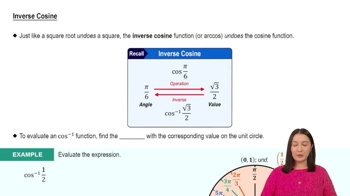
Inverse Cosine

Derivative of Inverse Functions

The derivative of an inverse function can be calculated using the formula (f^-1)'(y) = 1 / f'(x), where y = f(x). This relationship shows that the derivative of the inverse at a point is the reciprocal of the derivative of the original function at the corresponding point. This concept is essential for solving problems involving the derivatives of inverse functions.
Recommended video:
07:26
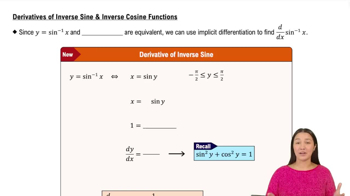
Derivatives of Inverse Sine & Inverse Cosine

Using Tables for Derivatives

When working with derivatives from a table, it is important to locate the relevant values for the function and its inverse. The table typically provides values of the function and its derivative at specific points, which can be used to find the necessary derivatives of the inverse function. Understanding how to interpret and extract information from such tables is key to solving derivative problems.
Recommended video:
05:44
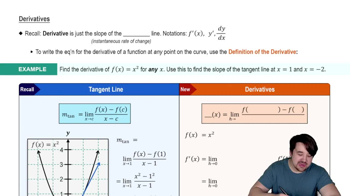
Derivatives