Ch. 3 - Derivatives
Briggs - Calculus: Early Transcendentals 3rd Edition
Briggs3rd EditionCalculus: Early TranscendentalsISBN: 9780136847243Not the one you use?Change textbook
Chapter 3, Problem 3.10.65a

62–65. {Use of Tech} Graphing f and f'
a. Graph f with a graphing utility.
f(x)=e^−x tan^−1 x on [0,∞)

Verified step by step guidance
1
Step 1: Understand the function f(x) = e^(-x) * tan^(-1)(x). This function is a product of the exponential function e^(-x) and the inverse tangent function tan^(-1)(x).
Step 2: Use a graphing utility or software that supports graphing, such as Desmos, GeoGebra, or a graphing calculator, to input the function f(x) = e^(-x) * tan^(-1)(x).
Step 3: Set the domain for the graph. Since the problem specifies the interval [0, ∞), ensure that the graphing utility is set to display the graph starting from x = 0 and extending towards positive infinity.
Step 4: Observe the behavior of the graph. Note how the exponential decay of e^(-x) affects the overall shape of the graph, and how the inverse tangent function, which approaches π/2 as x approaches infinity, influences the graph.
Step 5: Analyze the graph for key features such as intercepts, asymptotic behavior, and any points of interest. This will help in understanding the overall behavior of the function on the given interval.

Verified video answer for a similar problem:

This video solution was recommended by our tutors as helpful for the problem above.
Video duration:
5m
Was this helpful?

Key Concepts

Here are the essential concepts you must grasp in order to answer the question correctly.

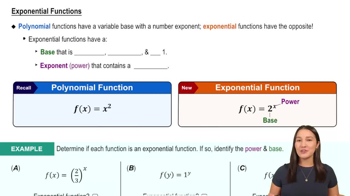
Exponential Functions

Exponential functions are mathematical expressions in the form f(x) = a * e^(bx), where 'e' is Euler's number (approximately 2.718). In the given function f(x) = e^(-x) * tan^(-1)(x), the term e^(-x) represents a decaying exponential function, which approaches zero as x increases. Understanding the behavior of exponential functions is crucial for analyzing the overall shape and limits of the graph.
Recommended video:
6:13
Exponential Functions

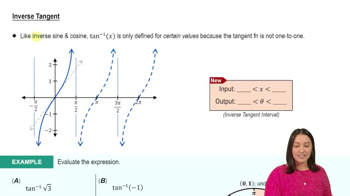
Inverse Tangent Function

The inverse tangent function, denoted as tan^(-1)(x) or arctan(x), is the function that returns the angle whose tangent is x. It has a range of (-π/2, π/2) and approaches these limits as x approaches ±∞. In the context of the function f(x) = e^(-x) * tan^(-1)(x), this function influences the growth of f(x) as x increases, particularly since tan^(-1)(x) approaches π/2.
Recommended video:
3:17
Inverse Tangent

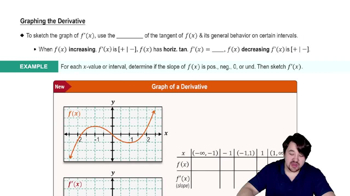
Graphing Utilities

Graphing utilities are software or tools that allow users to visualize mathematical functions and their derivatives. They can plot complex functions, helping to analyze their behavior over specified intervals. For the function f(x) = e^(-x) * tan^(-1)(x) on the interval [0, ∞), using a graphing utility will provide insights into the function's growth, decay, and asymptotic behavior, which is essential for understanding its overall characteristics.
Recommended video:
06:15
Graphing The Derivative