Ch. 2 - Limits
Briggs - Calculus: Early Transcendentals 3rd Edition
Briggs3rd EditionCalculus: Early TranscendentalsISBN: 9780136847243Not the one you use?Change textbook
Chapter 2, Problem 2.7.3

Which one of the following intervals is not symmetric about x=5?
a.(1, 9)
b.(4, 6)
c.(3, 8)
d.(4.5, 5.5)

Verified step by step guidance
1
Step 1: Understand the concept of symmetry about a point. An interval is symmetric about a point x = a if the distance from a to the left endpoint is equal to the distance from a to the right endpoint.
Step 2: For each interval, calculate the midpoint and check if it is equal to x = 5.
Step 3: For interval (1, 9), calculate the midpoint: (1 + 9) / 2.
Step 4: For interval (4, 6), calculate the midpoint: (4 + 6) / 2.
Step 5: For interval (3, 8), calculate the midpoint: (3 + 8) / 2.

Verified video answer for a similar problem:

This video solution was recommended by our tutors as helpful for the problem above.
Video duration:
2m
Was this helpful?

Key Concepts

Here are the essential concepts you must grasp in order to answer the question correctly.

Symmetry in Intervals

An interval is symmetric about a point if the distances from that point to the endpoints of the interval are equal. For an interval (a, b) to be symmetric about x = c, it must hold that c - a = b - c. This means that the midpoint of the interval must coincide with the point of symmetry.
Recommended video:
06:21
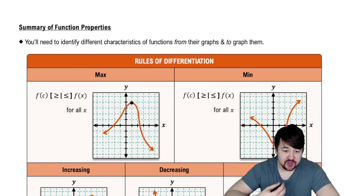
Properties of Functions

Endpoints of an Interval

The endpoints of an interval are the values that define the limits of the interval. For example, in the interval (a, b), 'a' is the left endpoint and 'b' is the right endpoint. Understanding the endpoints is crucial for determining the symmetry of the interval about a specific point.
Recommended video:
03:34
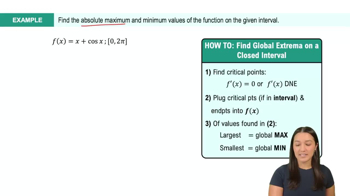
Finding Global Extrema (Extreme Value Theorem) Example 4

Calculating Midpoints

The midpoint of an interval (a, b) can be calculated using the formula (a + b) / 2. This value represents the center of the interval and is essential for assessing symmetry. If the midpoint does not equal the point of symmetry, the interval is not symmetric about that point.
Recommended video:
04:46
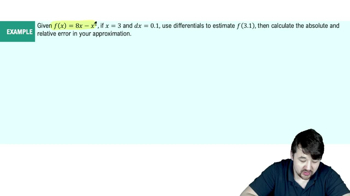
Determining Error and Relative Error Example 1