Ch. 2 - Limits
Briggs - Calculus: Early Transcendentals 3rd Edition
Briggs3rd EditionCalculus: Early TranscendentalsISBN: 9780136847243Not the one you use?Change textbook
Chapter 2, Problem 15b

Use the graph of f in the figure to find the following values or state that they do not exist. If a limit does not exist, explain why. <IMAGE>
limx1f(x)\(\lim\)_{x\(\to\)1^{-}}f\(\left\)(x\(\right\))

Verified step by step guidance
1
Identify the point of interest on the graph, which is x = 1, and observe the behavior of the function f(x) as x approaches 1 from the left (x -> 1^-).
Examine the values of f(x) for x slightly less than 1. This involves looking at the graph to see where the function is heading as it gets closer to x = 1 from the left side.
Determine if the function approaches a specific value as x approaches 1 from the left. This is the left-hand limit, denoted as \( \lim_{x \to 1^{-}} f(x) \).
If the function approaches a specific y-value, then that y-value is the left-hand limit. If the function does not approach a specific value (e.g., it jumps or oscillates), then the left-hand limit does not exist.
State the left-hand limit based on the graph's behavior. If it exists, provide the y-value it approaches; if not, explain why it does not exist (e.g., due to a jump discontinuity or oscillation).

Verified video answer for a similar problem:

This video solution was recommended by our tutors as helpful for the problem above.
Video duration:
1m
Was this helpful?

Key Concepts

Here are the essential concepts you must grasp in order to answer the question correctly.

Limits

A limit describes the value that a function approaches as the input approaches a certain point. In this context, we are interested in the left-hand limit, denoted as lim_{x→1^{-}}f(x), which examines the behavior of the function f(x) as x approaches 1 from values less than 1. Understanding limits is crucial for analyzing continuity and the behavior of functions at specific points.
Recommended video:
05:50
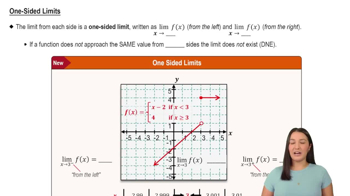
One-Sided Limits

Left-Hand Limit

The left-hand limit refers specifically to the value that a function approaches as the input approaches a certain point from the left side. It is denoted as lim_{x→c^{-}}f(x) for a point c. This concept is essential when determining the overall limit of a function at a point where the function may behave differently from the left and right sides.
Recommended video:
05:50
One-Sided Limits

Existence of Limits

For a limit to exist at a point, both the left-hand and right-hand limits must approach the same value. If they do not match, or if one or both limits do not exist, we conclude that the limit at that point does not exist. This concept is vital for understanding discontinuities in functions and for providing explanations when limits are found to be non-existent.
Recommended video:
03:07
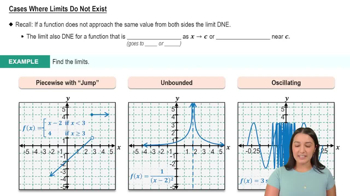
Cases Where Limits Do Not Exist