Ch. 2 - Limits
Briggs - Calculus: Early Transcendentals 3rd Edition
Briggs3rd EditionCalculus: Early TranscendentalsISBN: 9780136847243Not the one you use?Change textbook
Chapter 2, Problem 15

Suppose g(x) = {2x+1 if x≠0
5 if x=0.


Compute g(0) and lim x→0 g(x)

Verified step by step guidance
1
Step 1: Identify the value of the function g(x) at x = 0. According to the piecewise definition, g(0) = 5.
Step 2: To find \( \lim_{x \to 0} g(x) \), consider the behavior of g(x) as x approaches 0 from both sides.
Step 3: For x ≠ 0, g(x) = 2x + 1. Analyze the limit \( \lim_{x \to 0} (2x + 1) \).
Step 4: Calculate \( \lim_{x \to 0} (2x + 1) \) by substituting x = 0 into the expression 2x + 1, which simplifies to 1.
Step 5: Compare the limit \( \lim_{x \to 0} g(x) = 1 \) with g(0) = 5 to determine if the function is continuous at x = 0.

Verified video answer for a similar problem:

This video solution was recommended by our tutors as helpful for the problem above.
Video duration:
3m
Was this helpful?

Key Concepts

Here are the essential concepts you must grasp in order to answer the question correctly.

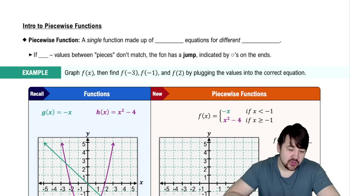
Piecewise Functions

A piecewise function is defined by different expressions based on the input value. In this case, g(x) has two definitions: one for x not equal to 0 and another specifically for x equal to 0. Understanding how to evaluate piecewise functions is crucial for determining values at specific points and analyzing their behavior around those points.
Recommended video:
05:36
Piecewise Functions

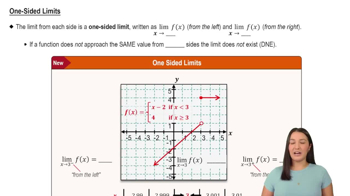
Limits

The limit of a function describes the behavior of the function as the input approaches a certain value. In this question, we need to find lim x→0 g(x), which involves evaluating the function as x gets close to 0, but not equal to 0. This concept is fundamental in calculus for understanding continuity and the behavior of functions at points of interest.
Recommended video:
05:50
One-Sided Limits

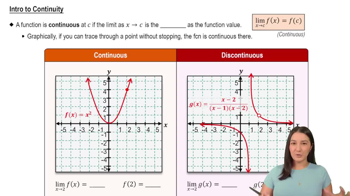
Continuity

A function is continuous at a point if the limit as x approaches that point equals the function's value at that point. For g(x), we need to check if lim x→0 g(x) equals g(0). If they are equal, g(x) is continuous at x=0; if not, it indicates a discontinuity, which is an important aspect of function analysis in calculus.
Recommended video:
05:34
Intro to Continuity
Related Practice
Textbook Question

Use the graph of f in the figure to find the following values or state that they do not exist. If a limit does not exist, explain why. <IMAGE>

limx1+f(x)\(\lim\)_{x\(\to\)1^{+}}f\(\left\)(x\(\right\))

1
views
Textbook Question

The position of an object moving vertically along a line is given by the function s(t)=4.9t2+30t+20s\(\left\)(t\(\right\))=-4.9t^2+30t+20. Find the average velocity of the object over the following intervals.

[0,3]\(\left\[\lbrack\)0,3\(\right\]\rbrack\)

2
views
Textbook Question

Use the graph of f in the figure to find the following values or state that they do not exist. If a limit does not exist, explain why. <IMAGE>

limx1f(x)\(\lim\)_{x\(\to\)1^{-}}f\(\left\)(x\(\right\))

Textbook Question

Let g(x)=x34x8x2g\(\left\)(x\(\right\))=\(\frac{x^3-4x}{8\left|x-2\right|}\). <IMAGE>

Make a conjecture about the values of limx2g(x){\(\displaystyle\]\lim\)_{x\(\to\)2^{-}}g\(\left\)(x\(\right\))}, limx2+g(x){\(\displaystyle\]\lim\)_{x\(\to\)2^{+}}g\(\left\)(x\(\right\))}, and limx2g(x){\(\displaystyle\]\lim\)_{x\(\to\)2}g\(\left\)(x\(\right\))} or state that they do not exist.

Textbook Question

The position of an object moving vertically along a line is given by the function s(t)=4.9t2+30t+20s\(\left\)(t\(\right\))=-4.9t^2+30t+20. Find the average velocity of the object over the following intervals.

[0,h]\(\left\[\lbrack\)0,h\(\right\]\rbrack\), where h>0h\(\gt{0}\) is a real number

1
views
Textbook Question

Determine the intervals of continuity for the parking cost function c introduced at the outset of this section (see figure). Consider 0≤t≤60. <FIGURE>

3
views