Ch. 2 - Limits
Briggs - Calculus: Early Transcendentals 3rd Edition
Briggs3rd EditionCalculus: Early TranscendentalsISBN: 9780136847243Not the one you use?Change textbook
Chapter 2, Problem 8b

Suppose the rental cost for a snowboard is \$25 for the first day (or any part of the first day) plus \$15 for each additional day (or any part of a day).
Evaluate lim t→2.9 f(t).

Verified step by step guidance
1
Step 1: Understand the function f(t). The function f(t) represents the rental cost for a snowboard based on the number of days t.
Step 2: Define the function f(t). For t = 1, the cost is \(25. For t > 1, the cost is \)25 + \$15(t - 1).
Step 3: Simplify the function for t > 1. The function becomes f(t) = 25 + 15(t - 1) = 25 + 15t - 15 = 15t + 10.
Step 4: Evaluate the limit as t approaches 2.9. Substitute t = 2.9 into the simplified function f(t) = 15t + 10.
Step 5: Calculate the expression 15(2.9) + 10 to find the limit.

Verified video answer for a similar problem:

This video solution was recommended by our tutors as helpful for the problem above.
Video duration:
3m
Was this helpful?

Key Concepts

Here are the essential concepts you must grasp in order to answer the question correctly.

Limits

In calculus, a limit is a fundamental concept that describes the behavior of a function as its input approaches a certain value. It helps in understanding how functions behave near specific points, which is crucial for defining derivatives and integrals. Evaluating limits often involves techniques such as substitution, factoring, or applying L'Hôpital's rule when dealing with indeterminate forms.
Recommended video:
05:50
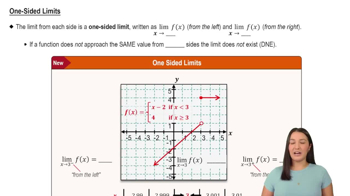
One-Sided Limits

Piecewise Functions

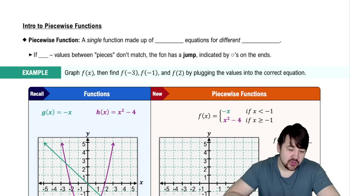
A piecewise function is defined by different expressions based on the input value. In the context of the snowboard rental cost, the function changes based on the number of days rented. Understanding how to evaluate piecewise functions is essential for determining the correct expression to use when calculating limits or function values at specific points.
Recommended video:
05:36
Piecewise Functions

Continuity

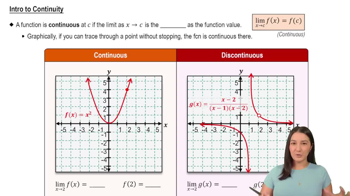
Continuity refers to a property of functions where small changes in the input result in small changes in the output. A function is continuous at a point if the limit as the input approaches that point equals the function's value at that point. Analyzing continuity is important when evaluating limits, as discontinuities can affect the limit's existence and value.
Recommended video:
05:34
Intro to Continuity