Ch. 2 - Limits
Briggs - Calculus: Early Transcendentals 3rd Edition
Briggs3rd EditionCalculus: Early TranscendentalsISBN: 9780136847243Not the one you use?Change textbook
Chapter 2, Problem 7b

Let f(x)=x24x2f\(\left\)(x\(\right\))=\(\frac{x^2-4}{x-2}\). <IMAGE>
Make a conjecture about the value of limx2x24x2{\(\displaystyle\]\lim\)_{x\(\to\)2}\(\frac{x^2-4}{x-2}\)}.

Verified step by step guidance
1
First, recognize that the expression \( \frac{x^2 - 4}{x - 2} \) is undefined at \( x = 2 \) because it results in division by zero. Therefore, we need to simplify the expression to evaluate the limit.
Notice that the numerator \( x^2 - 4 \) can be factored as a difference of squares: \( x^2 - 4 = (x - 2)(x + 2) \).
Substitute the factored form into the original expression: \( \frac{(x - 2)(x + 2)}{x - 2} \).
Cancel the common factor \( (x - 2) \) in the numerator and the denominator, which simplifies the expression to \( x + 2 \), provided \( x \neq 2 \).
Now, evaluate the limit of the simplified expression as \( x \to 2 \): \( \lim_{x \to 2} (x + 2) \). This can be directly computed by substituting \( x = 2 \) into the expression, leading to the conjecture about the limit.

Verified video answer for a similar problem:

This video solution was recommended by our tutors as helpful for the problem above.
Video duration:
2m
Was this helpful?

Key Concepts

Here are the essential concepts you must grasp in order to answer the question correctly.

Limits

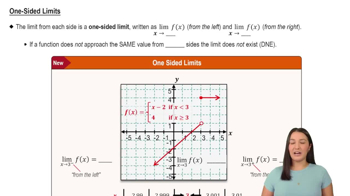
A limit is a fundamental concept in calculus that describes the behavior of a function as its input approaches a certain value. It helps in understanding the function's behavior near points where it may not be explicitly defined, such as points of discontinuity. In this question, we are interested in the limit of the function as x approaches 2, which is crucial for evaluating the function's value at that point.
Recommended video:
05:50
One-Sided Limits

Factoring Polynomials

Factoring polynomials involves rewriting a polynomial as a product of simpler polynomials or expressions. In the given function, f(x) = (x^2 - 4)/(x - 2), the numerator can be factored as (x - 2)(x + 2). This simplification is essential for evaluating the limit, as it allows us to cancel out the common factor in the numerator and denominator, making the limit easier to compute.
Recommended video:
07:00
Taylor Polynomials

Continuity

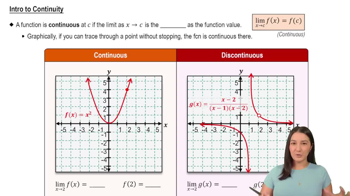
Continuity refers to a function being unbroken or having no gaps at a certain point. A function is continuous at a point if the limit as x approaches that point equals the function's value at that point. In this case, understanding continuity is important because it helps us determine whether the limit we compute will yield a valid function value at x = 2, which is initially undefined in the original function.
Recommended video:
05:34
Intro to Continuity