Ch. 2 - Limits
Briggs - Calculus: Early Transcendentals 3rd Edition
Briggs3rd EditionCalculus: Early TranscendentalsISBN: 9780136847243Not the one you use?Change textbook
Chapter 2, Problem 9b

Let g(t)=t9t3g\(\left\)(t\(\right\))=\(\frac{t-9}{\sqrt{t}\)-3}.
Make a conjecture about the value of limt9t9t3{\(\displaystyle\]\lim\)_{t\(\to\)9}\(\frac{t-9}{\sqrt{t}\)-3}}.

Verified step by step guidance
1
First, observe that directly substituting t = 9 into the function g(t) = \(\frac{t-9}{\sqrt{t}\)-3} results in an indeterminate form \(\frac{0}{0}\). This suggests that we need to simplify the expression to evaluate the limit.
To simplify, consider multiplying the numerator and the denominator by the conjugate of the denominator, which is \(\sqrt{t}\) + 3. This technique helps eliminate the square root in the denominator.
After multiplying, the expression becomes \(\frac{(t-9)(\sqrt{t}\)+3)}{(\(\sqrt{t}\)-3)(\(\sqrt{t}\)+3)}. The denominator simplifies to t - 9, as it is a difference of squares.
Now, the expression simplifies to \(\frac{(t-9)(\sqrt{t}\)+3)}{t-9}. Notice that the (t-9) terms in the numerator and denominator can be canceled out, provided t \(\neq\) 9.
After canceling, the expression simplifies to \(\sqrt{t}\) + 3. Now, substitute t = 9 into this simplified expression to find the limit, which is no longer indeterminate.

Verified video answer for a similar problem:

This video solution was recommended by our tutors as helpful for the problem above.
Video duration:
3m
Was this helpful?

Key Concepts

Here are the essential concepts you must grasp in order to answer the question correctly.

Limits

A limit is a fundamental concept in calculus that describes the behavior of a function as its input approaches a certain value. It helps in understanding the function's behavior near points where it may not be explicitly defined, such as points of discontinuity or indeterminate forms. In this question, we are interested in evaluating the limit of a function as t approaches 9.
Recommended video:
05:50
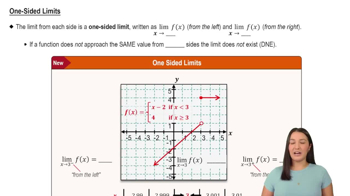
One-Sided Limits

Indeterminate Forms

Indeterminate forms occur in calculus when evaluating limits leads to expressions like 0/0 or ∞/∞, which do not provide clear information about the limit's value. In the given function, substituting t = 9 results in the form 0/0, necessitating further analysis, such as algebraic manipulation or L'Hôpital's Rule, to resolve the limit.
Recommended video:
6:20
Circles in General Form

L'Hôpital's Rule

L'Hôpital's Rule is a method used to evaluate limits of indeterminate forms by differentiating the numerator and denominator separately. If the limit of a function results in an indeterminate form, applying this rule can simplify the evaluation process, allowing for a clearer determination of the limit's value. This technique is particularly useful in the context of the limit presented in the question.
Recommended video: