Ch. 2 - Limits
Briggs - Calculus: Early Transcendentals 3rd Edition
Briggs3rd EditionCalculus: Early TranscendentalsISBN: 9780136847243Not the one you use?Change textbook
Chapter 2, Problem 11

Assume lim x→1 f(x)=8,lim x→1 g(x)=3, and lim x→1 h(x)=2 Compute the following limits and state the limit laws used to justify your computations.


lim x→1 f(x) / g(x)−h(x)

Verified step by step guidance
1
Identify the given limits: \( \lim_{{x \to 1}} f(x) = 8 \), \( \lim_{{x \to 1}} g(x) = 3 \), and \( \lim_{{x \to 1}} h(x) = 2 \).
Recognize that the problem requires finding \( \lim_{{x \to 1}} \frac{f(x)}{g(x) - h(x)} \).
Apply the limit law for quotients: \( \lim_{{x \to a}} \frac{f(x)}{g(x)} = \frac{\lim_{{x \to a}} f(x)}{\lim_{{x \to a}} g(x)} \) provided \( \lim_{{x \to a}} g(x) \neq 0 \).
Calculate the limit of the denominator: \( \lim_{{x \to 1}} (g(x) - h(x)) = \lim_{{x \to 1}} g(x) - \lim_{{x \to 1}} h(x) = 3 - 2 = 1 \).
Use the quotient limit law: \( \lim_{{x \to 1}} \frac{f(x)}{g(x) - h(x)} = \frac{\lim_{{x \to 1}} f(x)}{\lim_{{x \to 1}} (g(x) - h(x))} = \frac{8}{1} \).

Verified video answer for a similar problem:

This video solution was recommended by our tutors as helpful for the problem above.
Video duration:
2m
Was this helpful?

Key Concepts

Here are the essential concepts you must grasp in order to answer the question correctly.

Limit of a Function

The limit of a function describes the value that a function approaches as the input approaches a certain point. In this case, we have limits for functions f(x), g(x), and h(x) as x approaches 1. Understanding limits is crucial for evaluating expressions involving functions at specific points.
Recommended video:
06:11
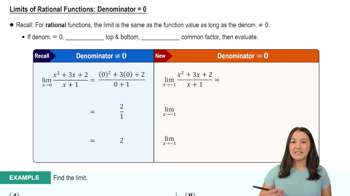
Limits of Rational Functions: Denominator = 0

Limit Laws

Limit laws are rules that allow us to compute the limits of functions based on the limits of their components. For example, the quotient law states that if the limits of f(x) and g(x) exist and g(x) is not zero at the limit point, then lim x→c (f(x)/g(x)) = lim x→c f(x) / lim x→c g(x). These laws are essential for simplifying and calculating complex limits.
Recommended video:
05:50
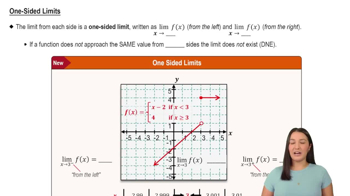
One-Sided Limits

Algebraic Manipulation of Limits

Algebraic manipulation involves rearranging and simplifying expressions to facilitate limit evaluation. In the given problem, we need to compute the limit of the expression f(x)/g(x) - h(x). This requires applying limit laws and performing algebraic operations to find the limit of the entire expression as x approaches 1.
Recommended video:
05:21
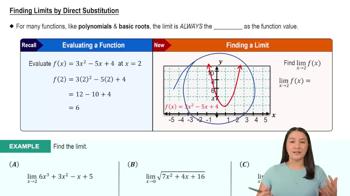
Finding Limits by Direct Substitution