
Ch. 11 - Power Series
Briggs - Calculus: Early Transcendentals 3rd Edition
Briggs3rd EditionCalculus: Early TranscendentalsISBN: 9780136847243Not the one you use?Change textbook
Chapter 11, Problem 11.RE.11b

ƒ(x) = eˣ, a = 0; e-0.08


b. Use the Taylor polynomials to approximate the given expression. Make a table showing the approximations and the absolute error in these approximations using a calculator for the exact function value.

Verified step by step guidance
1
Identify the function and the point of expansion: Here, the function is \(f(x) = e^{x}\) and the expansion point is \(a = 0\). This means we will use the Taylor series of \(e^{x}\) centered at 0, also known as the Maclaurin series.
Recall the Taylor polynomial formula for \(f(x)\) centered at \(a\): \[T_n(x) = \sum_{k=0}^{n} \frac{f^{(k)}(a)}{k!} (x - a)^k\] Since \(f(x) = e^{x}\), all derivatives \(f^{(k)}(x) = e^{x}\), so at \(a=0\), \(f^{(k)}(0) = 1\) for all \(k\).
Write the Taylor polynomials of various degrees for \(x = -0.08\): \[T_n(-0.08) = \sum_{k=0}^{n} \frac{(-0.08)^k}{k!}\] Calculate these partial sums for increasing values of \(n\) (e.g., \(n=1, 2, 3, 4, 5\)) to get successive approximations.
Calculate the exact value of \(e^{-0.08}\) using a calculator or software to use as a reference for error calculation.
Create a table listing each polynomial degree \(n\), the corresponding approximation \(T_n(-0.08)\), and the absolute error defined as: \[\text{Absolute Error} = |e^{-0.08} - T_n(-0.08)|\] This will show how the approximation improves as \(n\) increases.

Verified video answer for a similar problem:

This video solution was recommended by our tutors as helpful for the problem above.
Video duration:
3m
Was this helpful?

Key Concepts

Here are the essential concepts you must grasp in order to answer the question correctly.

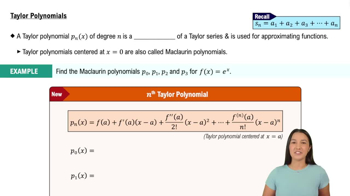
Taylor Polynomials

Taylor polynomials approximate a function near a point by using its derivatives at that point. For a function f(x) centered at a, the nth-degree Taylor polynomial sums terms involving derivatives of f at a, multiplied by powers of (x - a). This provides a polynomial approximation that becomes more accurate as n increases.
Recommended video:
07:00
Taylor Polynomials

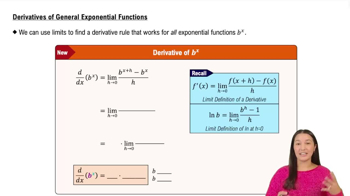
Exponential Function and Its Derivatives

The exponential function e^x is unique because its derivative at any point is equal to the function itself. This property simplifies the Taylor polynomial for e^x, as all derivatives at a point a are e^a. Understanding this helps in constructing the polynomial terms efficiently.
Recommended video:
04:50
Derivatives of General Exponential Functions

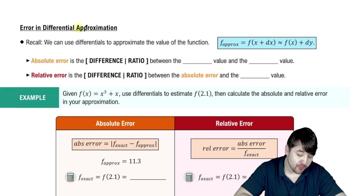
Absolute Error in Approximations

Absolute error measures the difference between the exact value of a function and its approximation. Calculating this error helps evaluate the accuracy of Taylor polynomial approximations. It is found by subtracting the approximate value from the exact value and taking the absolute value.
Recommended video:
04:57
Determining Error and Relative Error