
Textbook Question
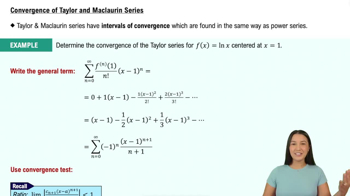
Taylor series and interval of convergence
a. Use the definition of a Taylor/Maclaurin series to find the first four nonzero terms of the Taylor series for the given function centered at a.
f(x) = tan ⁻¹ (x/2), a = 0

 Verified step by step guidance
 08:26
08:26
 04:50
04:50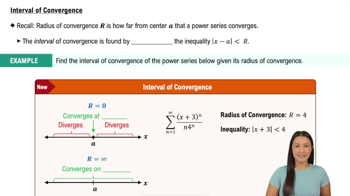 08:44
08:44Taylor series and interval of convergence
a. Use the definition of a Taylor/Maclaurin series to find the first four nonzero terms of the Taylor series for the given function centered at a.
f(x) = tan ⁻¹ (x/2), a = 0
Taylor series
a. Use the definition of a Taylor series to find the first four nonzero terms of the Taylor series for the given function centered at a.
f(x) = ln x, a = 3
Find the remainder term Rₙ(x) for the Taylor series centered at 0 for the following functions. Find an upper bound for the magnitude of the remainder on the given interval for the given value of n. (The bound is not unique.)
ƒ(x) = ln (1 - x); bound R₃(x), for |x| < 1/2
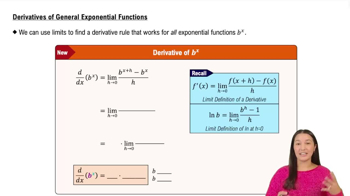
ƒ(x) = eˣ, a = 0; e-0.08
b. Use the Taylor polynomials to approximate the given expression. Make a table showing the approximations and the absolute error in these approximations using a calculator for the exact function value.
Radius and interval of convergence Use the Ratio Test or the Root Test to determine the radius of convergence of the following power series. Test the endpoints to determine the interval of convergence, when appropriate.
x +x³/3 +x⁵/5 +x⁷/7 + ...
Taylor series
a. Use the definition of a Taylor series to find the first four nonzero terms of the Taylor series for the given function centered at a.
f(x) = 2ˣ, a = 1