
Ch. 11 - Power Series
Briggs - Calculus: Early Transcendentals 3rd Edition
Briggs3rd EditionCalculus: Early TranscendentalsISBN: 9780136847243Not the one you use?Change textbook
Chapter 11, Problem 11.RE.11a

ƒ(x) = eˣ, a = 0; e-0.08


a. Find the Taylor polynomials of order n = 1 and n = 2 for the given functions centered at the given point a.

Verified step by step guidance
1
Identify the function and the center point: here, the function is \(f(x) = e^{x}\) and the center point is \(a = 0\).
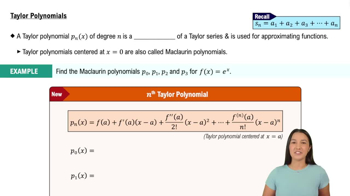
Recall the general formula for the Taylor polynomial of order \(n\) centered at \(a\): \[T_n(x) = \sum_{k=0}^n \frac{f^{(k)}(a)}{k!} (x - a)^k,\] where \(f^{(k)}(a)\) is the \(k\)-th derivative of \(f\) evaluated at \(a\).
Calculate the derivatives of \(f(x) = e^{x}\) and evaluate them at \(a=0\): - \(f(x) = e^{x}\), so \(f(0) = e^{0} = 1\), - \(f'(x) = e^{x}\), so \(f'(0) = 1\), - \(f''(x) = e^{x}\), so \(f''(0) = 1\).
Write the Taylor polynomial of order \(n=1\) using the formula: \[T_1(x) = f(0) + f'(0)(x - 0) = 1 + 1 \cdot x = 1 + x.\]
Write the Taylor polynomial of order \(n=2\) using the formula: \[T_2(x) = f(0) + f'(0)(x - 0) + \frac{f''(0)}{2!}(x - 0)^2 = 1 + x + \frac{1}{2} x^2.\]

Verified video answer for a similar problem:

This video solution was recommended by our tutors as helpful for the problem above.
Video duration:
2m
Was this helpful?

Key Concepts

Here are the essential concepts you must grasp in order to answer the question correctly.

Taylor Polynomials

Taylor polynomials approximate a function near a point using a finite sum of its derivatives at that point. The nth-order Taylor polynomial includes terms up to the nth derivative, providing increasingly accurate approximations as n increases.
Recommended video:
07:00
Taylor Polynomials

Derivatives of Exponential Functions

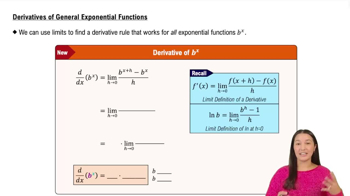
The function f(x) = e^x has the unique property that all its derivatives are equal to e^x. This simplifies finding Taylor polynomials since each derivative evaluated at a point a is e^a, making the polynomial terms straightforward to compute.
Recommended video:
04:50
Derivatives of General Exponential Functions

Centering the Polynomial at a Point

Centering a Taylor polynomial at a point a means the polynomial approximates the function near x = a. The polynomial uses (x - a) as the variable, ensuring the approximation is most accurate close to this center.
Recommended video:
07:00
Taylor Polynomials
Related Practice
Textbook Question

Radius and interval of convergence Use the Ratio Test or the Root Test to determine the radius of convergence of the following power series. Test the endpoints to determine the interval of convergence, when appropriate.


Σ (x - 1)ᵏ/(k5ᵏ)

k = 1

Textbook Question

Radius and interval of convergence Use the Ratio Test or the Root Test to determine the radius of convergence of the following power series. Test the endpoints to determine the interval of convergence, when appropriate.


Σ x⁴ᵏ/k²

k = 1

1
views
Textbook Question

Find the remainder term Rₙ(x) for the Taylor series centered at 0 for the following functions. Find an upper bound for the magnitude of the remainder on the given interval for the given value of n. (The bound is not unique.)


ƒ(x) = eˣ; bound R₃(x), for |x| < 1

Textbook Question

Find the remainder term Rₙ(x) for the Taylor series centered at 0 for the following functions. Find an upper bound for the magnitude of the remainder on the given interval for the given value of n. (The bound is not unique.)


ƒ(x) = ln (1 - x); bound R₃(x), for |x| < 1/2

Textbook Question

ƒ(x) = eˣ, a = 0; e-0.08


b. Use the Taylor polynomials to approximate the given expression. Make a table showing the approximations and the absolute error in these approximations using a calculator for the exact function value.

Textbook Question

Radius and interval of convergence Use the Ratio Test or the Root Test to determine the radius of convergence of the following power series. Test the endpoints to determine the interval of convergence, when appropriate.


Σ (x/9)³ᵏ

k = 0