Ch. 11 - Power Series
Briggs - Calculus: Early Transcendentals 3rd Edition
Briggs3rd EditionCalculus: Early TranscendentalsISBN: 9780136847243Not the one you use?Change textbook
Chapter 11, Problem 11.1.52

{Use of Tech} Estimating errors Use the remainder to find a bound on the error in approximating the following quantities with the nth-order Taylor polynomial centered at 0. Estimates are not unique.


ln 1.04, n=3

Verified step by step guidance
1
Identify the function and the point of expansion: here, the function is \(f(x) = \ln(1+x)\), and the Taylor polynomial is centered at \(0\) (Maclaurin series).
Write the general form of the remainder (error) term for the Taylor polynomial of order \(n\) centered at \(0\): the Lagrange form of the remainder is given by \(R_n(x) = \frac{f^{(n+1)}(c)}{(n+1)!} x^{n+1}\) where \(c\) is some number between \(0\) and \(x\).
Calculate the \((n+1)\)-th derivative of \(f(x) = \ln(1+x)\): First derivative: \(f'(x) = \frac{1}{1+x}\) Second derivative: \(f''(x) = -\frac{1}{(1+x)^2}\) Third derivative: \(f^{(3)}(x) = \frac{2}{(1+x)^3}\) Fourth derivative: \(f^{(4)}(x) = -\frac{6}{(1+x)^4}\) Since \(n=3\), we need the 4th derivative for the remainder term.
Substitute \(n=3\) and \(x=0.04\) into the remainder formula: \(R_3(0.04) = \frac{f^{(4)}(c)}{4!} (0.04)^4\) where \(c\) is between \(0\) and \(0.04\).
Find an upper bound for \(|f^{(4)}(c)|\) on the interval \([0, 0.04]\): since \(f^{(4)}(x) = -\frac{6}{(1+x)^4}\), its absolute value is \(\frac{6}{(1+x)^4}\). The maximum occurs at the smallest denominator, which is at \(x=0\), so \(|f^{(4)}(c)| \leq \frac{6}{1^4} = 6\). Use this to bound the error: \(|R_3(0.04)| \leq \frac{6}{4!} (0.04)^4\).

Verified video answer for a similar problem:

This video solution was recommended by our tutors as helpful for the problem above.
Video duration:
5m
Was this helpful?

Key Concepts

Here are the essential concepts you must grasp in order to answer the question correctly.

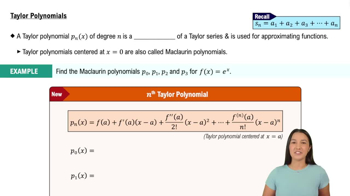
Taylor Polynomial Approximation

A Taylor polynomial approximates a function near a point using a finite sum of its derivatives at that point. The nth-order Taylor polynomial uses derivatives up to order n, providing an approximation that becomes more accurate as n increases or as the input approaches the center.
Recommended video:
07:00
Taylor Polynomials

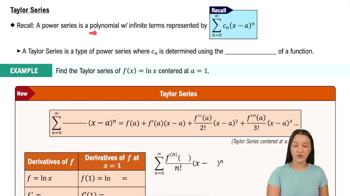
Remainder (Error) Term in Taylor Series

The remainder term quantifies the difference between the actual function value and its Taylor polynomial approximation. It provides an upper bound on the error, often expressed using the Lagrange form, which involves the (n+1)th derivative evaluated at some point in the interval.
Recommended video:
08:42
Taylor Series

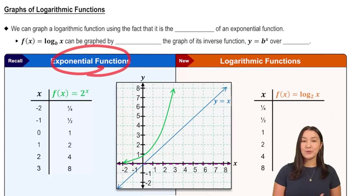
Bounding the Error for Logarithmic Functions

To estimate the error when approximating ln(1.04) with a Taylor polynomial centered at 0, one must analyze the derivatives of ln(x) and find a maximum bound for the remainder term on the interval between 0 and 0.04. This ensures the error estimate is valid and helps assess the approximation's accuracy.
Recommended video:
5:26
Graphs of Logarithmic Functions
Related Practice
Textbook Question

Suppose you know the Maclaurin series for f and that it converges to f(x) for |x|<1. How do you find the Maclaurin series for f(x²) and where does it converge?

Textbook Question

{Use of Tech} A different kind of approximation When approximating a function f using a Taylor polynomial, we use information about f and its derivative at one point. An alternative approach (called interpolation) uses information about f at several different points. Suppose we wish to approximate f(x)=sin x on the interval [0, π].


a. Write the (quadratic) Taylor polynomial p₂ for f centered at π/2.


b. Now consider a quadratic interpolating polynomial q(x) = ax² + bx + c. The coefficients a, b, and c are chosen such that the following conditions are satisfied:

q(0) = f(0), q(π/2) = f(π/2), and q(π) = f(π)


Show that q(x) = −(4/π²)x² + (4/π)x.


c. Graph f, p₂, and q on [0, π].


d. Find the error in approximating f(x) = sin x at the points π/4, π/2, 3π/4, and π using p₂ and q.


e. Which function, p₂ or q, is a better approximation to f on [0, π]? Explain.

Textbook Question

Taylor series Write out the first three nonzero terms of the Taylor series for the following functions centered at the given point a. Then write the series using summation notation.

ƒ(x) = tan⁻¹(4x), a = 0

Textbook Question

{Use of Tech} Maximum error Use the remainder term to find a bound on the error in the following approximations on the given interval. Error bounds are not unique.


√(1+x) ≈ 1 + x/2 on [−0.1,0.1]

Textbook Question

Probability: tossing for a head The expected (average) number of tosses of a fair coin required to obtain the first head is ∑ₖ₌₁∞ k(1/2)ᵏ. Evaluate this series and determine the expected number of tosses. (Hint: Differentiate a geometric series.) 

Textbook Question

{Use of Tech} Estimating errors Use the remainder to find a bound on the error in approximating the following quantities with the nth-order Taylor polynomial centered at 0. Estimates are not unique.


sin 0.3, n = 4