Ch. 11 - Power Series
Briggs - Calculus: Early Transcendentals 3rd Edition
Briggs3rd EditionCalculus: Early TranscendentalsISBN: 9780136847243Not the one you use?Change textbook
Chapter 11, Problem 11.1.88

{Use of Tech} A different kind of approximation When approximating a function f using a Taylor polynomial, we use information about f and its derivative at one point. An alternative approach (called interpolation) uses information about f at several different points. Suppose we wish to approximate f(x)=sin x on the interval [0, π].


a. Write the (quadratic) Taylor polynomial p₂ for f centered at π/2.


b. Now consider a quadratic interpolating polynomial q(x) = ax² + bx + c. The coefficients a, b, and c are chosen such that the following conditions are satisfied:
q(0) = f(0), q(π/2) = f(π/2), and q(π) = f(π)


Show that q(x) = −(4/π²)x² + (4/π)x.


c. Graph f, p₂, and q on [0, π].


d. Find the error in approximating f(x) = sin x at the points π/4, π/2, 3π/4, and π using p₂ and q.


e. Which function, p₂ or q, is a better approximation to f on [0, π]? Explain.

Verified step by step guidance
1
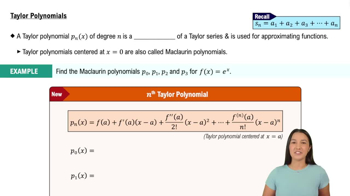
a. To write the quadratic Taylor polynomial \(p_2\) for \(f(x) = \sin x\) centered at \(x = \frac{\pi}{2}\), start by computing the function value and the first two derivatives at \(x = \frac{\pi}{2}\). Recall the Taylor polynomial formula up to degree 2: \[p_2(x) = f\left(\frac{\pi}{2}\right) + f'\left(\frac{\pi}{2}\right)(x - \frac{\pi}{2}) + \frac{f''\left(\frac{\pi}{2}\right)}{2}(x - \frac{\pi}{2})^2\] Calculate \(f\left(\frac{\pi}{2}\right)\), \(f'\left(\frac{\pi}{2}\right)\), and \(f''\left(\frac{\pi}{2}\right)\) explicitly.
b. For the quadratic interpolating polynomial \(q(x) = ax^2 + bx + c\), use the given conditions: \[q(0) = f(0), \quad q\left(\frac{\pi}{2}\right) = f\left(\frac{\pi}{2}\right), \quad q(\pi) = f(\pi)\] Substitute these points into \(q(x)\) to form a system of three equations: \[c = f(0)\] \[a\left(\frac{\pi}{2}\right)^2 + b\left(\frac{\pi}{2}\right) + c = f\left(\frac{\pi}{2}\right)\] \[a\pi^2 + b\pi + c = f(\pi)\] Solve this system for \(a\), \(b\), and \(c\) to find the explicit form of \(q(x)\).
c. To graph \(f(x) = \sin x\), \(p_2(x)\), and \(q(x)\) on the interval \([0, \pi]\), plot each function using the expressions found in parts (a) and (b). This visual comparison helps to see how well each polynomial approximates \(\sin x\) over the interval.
d. To find the error at points \(x = \frac{\pi}{4}, \frac{\pi}{2}, \frac{3\pi}{4}, \pi\), compute the absolute difference between \(f(x)\) and each approximation: \[\text{Error for } p_2 = |f(x) - p_2(x)|\] \[\text{Error for } q = |f(x) - q(x)|\] Calculate these values for each specified \(x\) to quantify the accuracy of each polynomial at those points.
e. To determine which polynomial, \(p_2\) or \(q\), is a better approximation on \([0, \pi]\), compare the errors computed in part (d) across the points. Consider the nature of each approximation: \(p_2\) uses local derivative information at \(\frac{\pi}{2}\), while \(q\) uses interpolation at three points. Discuss which method yields smaller errors overall and why, based on the error behavior and the construction of the polynomials.

Verified video answer for a similar problem:

This video solution was recommended by our tutors as helpful for the problem above.
Video duration:
2m
Was this helpful?

Key Concepts

Here are the essential concepts you must grasp in order to answer the question correctly.

Taylor Polynomial Approximation

A Taylor polynomial approximates a function near a single point using the function's derivatives at that point. For a quadratic Taylor polynomial, the function, its first derivative, and second derivative at the center point determine the polynomial. This method captures local behavior but may not approximate well far from the center.
Recommended video:
07:00
Taylor Polynomials

Polynomial Interpolation

Polynomial interpolation constructs a polynomial that exactly matches the function's values at several distinct points. For quadratic interpolation, three points determine the coefficients of a second-degree polynomial. This approach uses global information and can provide a better fit over an interval than a Taylor polynomial centered at one point.
Recommended video:
07:00
Taylor Polynomials

Error Analysis in Approximation

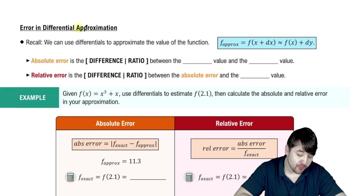
Error analysis compares the difference between the original function and its approximation at specific points. Evaluating errors at multiple points helps assess which approximation is more accurate over an interval. Understanding error behavior guides the choice between Taylor and interpolating polynomials.
Recommended video:
04:57
Determining Error and Relative Error